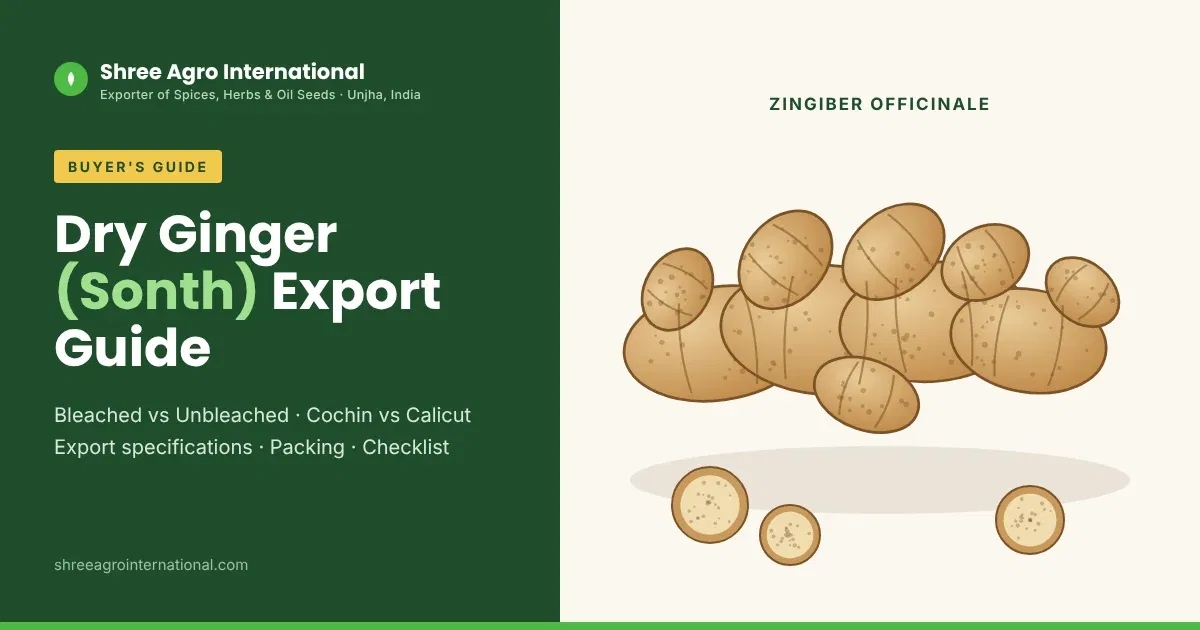
Dry ginger is fresh ginger rhizome that has been cleaned, often peeled and sun-dried until its moisture falls to around 10–12%. For importers, its quality comes down to four things: volatile oil content, moisture, cleanliness (ash and extraneous matter) and whether it is bleached or unbleached. This guide explains each one, the main Indian trade types, and what to check before you place a bulk order.
What Is Dry Ginger?
Dry ginger, known in India as sonth or saunth, is the dried rhizome of Zingiber officinale. Drying removes most of the water, which makes ginger stable enough to store and ship across the world without refrigeration.
In the spice trade, dry ginger is mainly bought for three uses:
- Grinding into ginger powder for spice blends, bakery, beverages and retail packs
- Extraction of ginger oleoresin and essential oil for the flavour, food and nutraceutical industries
- Whole use in traditional medicine, herbal teas and regional cooking
Each use needs a slightly different quality, which is why understanding the grades matters.
How Dry Ginger Is Made
- Harvesting: mature rhizomes are dug up once the plant leaves begin to dry.
- Washing and soaking: soil and roots are removed.
- Peeling or scraping: the outer skin is scraped off by hand or machine. Peeling should remove only the thin corky skin, because a thick peel takes away part of the essential oil and flavour.
- Drying: the rhizomes are sun-dried (or mechanically dried) until the moisture drops to roughly 7–12%.
- Bleaching (optional): some ginger is treated to give it a lighter, more uniform colour (see below).
- Cleaning and grading: extraneous matter, light pieces and damaged rhizomes are removed, and the lots are graded by size and appearance.
- Packing: the ginger is packed in PP, jute or paper bags for export.
Drying also changes the chemistry. Heat converts part of the gingerols in fresh ginger into shogaols, which is one reason dry ginger tastes sharper and more pungent than fresh ginger.
Bleached vs Unbleached Dry Ginger
This is the first question most buyers need to answer.
| Unbleached dry ginger | Bleached dry ginger | |
|---|---|---|
| Appearance | Natural pale brown to light yellow | Whiter, more uniform colour |
| Treatment | Peeled/scraped and dried only | Additionally treated (traditionally with lime) to lighten the colour |
| Calcium (as CaO) | Lower | Higher, because of the treatment, so standards allow more |
| Total ash | Lower limit | Standards allow a higher limit |
| Preferred by | Grinders, oleoresin extractors, natural/organic buyers | Markets where appearance of the whole rhizome matters |
| Organic | Suitable | Check the treatment against the organic standard before ordering |
International standards set separate limits for the two. Specifications based on ISO 1003 typically allow calcium oxide up to 1.1% for unbleached and 2.5% for bleached ginger, and total ash up to 8% unbleached vs 12% bleached (whole ginger, dry basis).
Buyer tip: if the ginger will be ground or extracted, unbleached is usually the better choice. Bleaching adds nothing to flavour and increases ash. Always state “bleached” or “unbleached” clearly in your purchase specification.
Cochin vs Calicut Ginger
Indian dry ginger is traditionally traded under two names linked to Kerala’s historic spice ports:
| Cochin ginger | Calicut ginger | |
|---|---|---|
| Colour | Light yellow / buff | More reddish-brown |
| Aroma | Delicate, with a lemon-like note | Delicate, slightly more earthy |
| Typical use | Premium grinding, retail, beverages | Grinding, extraction, blends |
| Reputation | Light colour and fine flavour; one of the best-known origins in world trade | Well-known Indian trade type, widely used industrially |
Indian Standard IS 1908 also uses trade designations such as garbled (cleaned, with light pieces removed) and ungarbled, and bleached or non-bleached, for these types.
Today these names describe a trade type and quality more than an exact place of growth. When you buy, ask the supplier for the actual specification and a sample rather than relying on the name alone.
Forms of Dry Ginger
| Form | Description | Best for |
|---|---|---|
| Whole | Full dried rhizomes (“hands”) | Long storage, grinding at destination, retail whole spice |
| Split | Rhizomes split lengthwise before drying (dries faster) | Grinding, extraction |
| Sliced | Thin slices | Tea blends, herbal products, quick extraction |
| Pieces / cut | Small irregular pieces | Grinding, oleoresin |
| Powder | Ground dry ginger | Spice blends, bakery, beverages, retail packs |
Whole and split ginger keep their volatile oils longer than powder, because the oils start oxidising once the ginger is ground. Many large buyers import whole or split ginger and grind it close to the point of use.
Key Quality Parameters for Export
The table below shows typical limits in national standards based on ISO 1003. Your contract specification may be stricter, so always agree the exact numbers with your supplier.
| Parameter | Whole / pieces | Ground | Why it matters |
|---|---|---|---|
| Moisture (max) | 12% | 11% | Above this, the risk of mould and insect damage rises |
| Volatile oil (min, ml/100 g) | 1.5 | 1.0 | The main measure of aroma and strength |
| Total ash (max) – unbleached | 8% | 8% | Indicates mineral content and soil/dust |
| Total ash (max) – bleached | 12% | 12% | Higher because of the bleaching treatment |
| Acid-insoluble ash (max) | 1.5% | 1.5% | Indicates sand and soil contamination |
| Calcium as CaO (max) – unbleached / bleached | 1.1% / 2.5% | 1.1% / 2.5% | Shows whether the ginger was lime-treated |
| Extraneous matter (max) | 2% | – | Stones, stems and other foreign material |
The current international standard is ISO 1003:2025 (Spices and condiments – Whole/pieces and ground dried ginger – Specification). Ask your supplier which standard their specification follows.
Other checks importers usually ask for:
- Microbiology: Salmonella absent in 25 g, plus total plate count, yeast and mould, and E. coli
- Mycotoxins: aflatoxins and ochratoxin A, especially for the EU
- Pesticide residues: compliance with the destination market’s MRLs
- Physical checks: insect damage, mould, colour, size and fibre
Shree Agro International’s standard dry ginger specification (from our dry ginger product page):
| Parameter | Value |
|---|---|
| Botanical name | Zingiber officinale |
| Type | Machine cleaned |
| Purity | 99.00% |
| Moisture | 12% max |
| Colour | Light yellow to pale brown |
| Flavour profile | Warm, spicy, pungent |
| Salmonella | Absent in 25 g |
Need volatile oil, ash or residue values for your market? Ask us for a Certificate of Analysis (COA) with your sample.
How to Choose the Right Dry Ginger for Your Business
| Your business | What to ask for |
|---|---|
| Spice grinder / blender | Unbleached, whole or split, good volatile oil, low ash and acid-insoluble ash |
| Oleoresin / essential oil extractor | Unbleached, high volatile oil and oleoresin yield; ask for the VO % on the COA |
| Retail / private label (whole) | Clean, uniform pieces, good colour; bleached only if your market prefers it |
| Herbal tea / nutraceutical | Sliced or cut, low microbial count, pesticide-residue tested; organic if required |
| Organic brand | Certified organic (NPOP / USDA Organic / EU Organic), unbleached, with full documents |
Common Quality Problems (and How to Avoid Them)
- Mould and musty smell: caused by drying too little or moisture getting in during transit. Ask for moisture test results and use moisture-protective packing. See our guide on preventing moisture and mould in bulk spice shipments.
- Low volatile oil: caused by over-peeling, slow drying or old stock. Ask for the VO % and the crop year.
- High ash or sand: caused by poor washing and cleaning. Check total ash and acid-insoluble ash.
- Insect damage: caused by long storage without fumigation-free pest control. Inspect the sample and set a maximum % in the contract.
- Unexpected bleaching: ask for the calcium (CaO) value if you need unbleached ginger.
For a full list of the tests to request, read Quality Tests Importers Need Before Buying Indian Spices.
Packaging and Container Loading
| Packaging | Sizes |
|---|---|
| PP bags | 25 kg / 50 kg |
| Jute bags | 25 kg / 50 kg |
| Paper bags | 10 kg / 25 kg |
| Custom / private label | As per buyer’s requirement |
| Container | Approx. load |
|---|---|
| 20 ft | 13–14 metric tons |
| 40 ft | 25–26 metric tons |
The exact load depends on the form (whole, sliced or powder) and the bag type.
Storage Tips After Import
- Store in a cool, dry, well-ventilated warehouse, off the floor, on pallets.
- Keep humidity low and avoid temperature swings that cause condensation.
- Keep it away from strong-smelling goods, because ginger picks up odours.
- Use first-in, first-out, since volatile oil slowly declines over time.
- Grind close to the time of use for the best aroma.
Pre-Order Checklist for Dry Ginger Buyers
- Form: whole / split / sliced / pieces / powder
- Bleached or unbleached
- Organic, IPM or conventional
- Specification: moisture, volatile oil, total ash, acid-insoluble ash, CaO, extraneous matter
- Microbiology, aflatoxin / ochratoxin and pesticide residue limits for your market
- Sample approved and COA received
- Packaging type, bag size, labelling and marking
- Quantity, Incoterm (FOB/CIF), destination port and shipment date
- Documents: COA, phytosanitary certificate, certificate of origin, organic certificate (if applicable)
Frequently Asked Questions
Dry ginger is called sonth or saunth in Hindi and soonth in Gujarati. In international trade it is sold as dried ginger or dry ginger.
Fresh ginger contains a lot of water and has a juicy, mildly pungent taste. Dry ginger has had most of its moisture removed, so it keeps for a long time and has a sharper, warmer flavour, partly because drying converts some gingerols into shogaols. Dry ginger is the form used for ginger powder, oleoresin and long-distance export.
For grinding, extraction and organic products, unbleached ginger is usually preferred because it is untreated and has lower ash and calcium. Bleached ginger is chosen mainly for appearance in markets that prefer a whiter whole rhizome.
Standards based on ISO 1003 typically set a minimum of 1.5 ml/100 g for whole ginger and 1.0 ml/100 g for ground ginger. Oleoresin and oil extractors often ask for higher values, so agree the minimum in your contract.
Whole dry ginger is usually specified at 12% moisture maximum, and ground ginger at 11% maximum. Lower moisture means better storage and less risk of mould.
Whole dry ginger stored in cool, dry conditions keeps its quality much longer than powder. Aroma slowly fades as volatile oil is lost, so use stock on a first-in, first-out basis and grind close to the time of use.
Yes. Shree Agro International supplies dry ginger in organic and IPM grades, depending on availability and the buyer’s requirements, with machine cleaning and custom packaging. Contact us for the current specification and a sample.
Buy Dry Ginger from Shree Agro International
Shree Agro International is a Government-recognised Three Star Export House in Unjha, Gujarat, supplying whole spices, ground spices and oil seeds to buyers in 40+ countries. Our dry ginger is machine cleaned to 99% purity, tested before dispatch, and packed in PP, jute, paper or private-label packaging.
Prefer to grind at origin? See our ginger powder.
Email: info@shreeagrointernational.com · Phone / WhatsApp: +91 96388 25444
References
- ISO 1003:2025, Spices and condiments – Whole/pieces and ground dried ginger (Zingiber officinale Roscoe) – Specification: iso.org
- Tanzania Bureau of Standards draft dried ginger standard (WTO TBT notification, based on ISO 1003 limits): wto.org (PDF)
- Codex draft standard for dried ginger (Brazil Ministry of Agriculture copy): gov.br (PDF)
- IS 1908:2008, Indian Standard for dry ginger (trade designations): law.resource.org (PDF)
- Ginger processing and trade types (e-PG Pathshala, INFLIBNET): inflibnet.ac.in (PDF)