


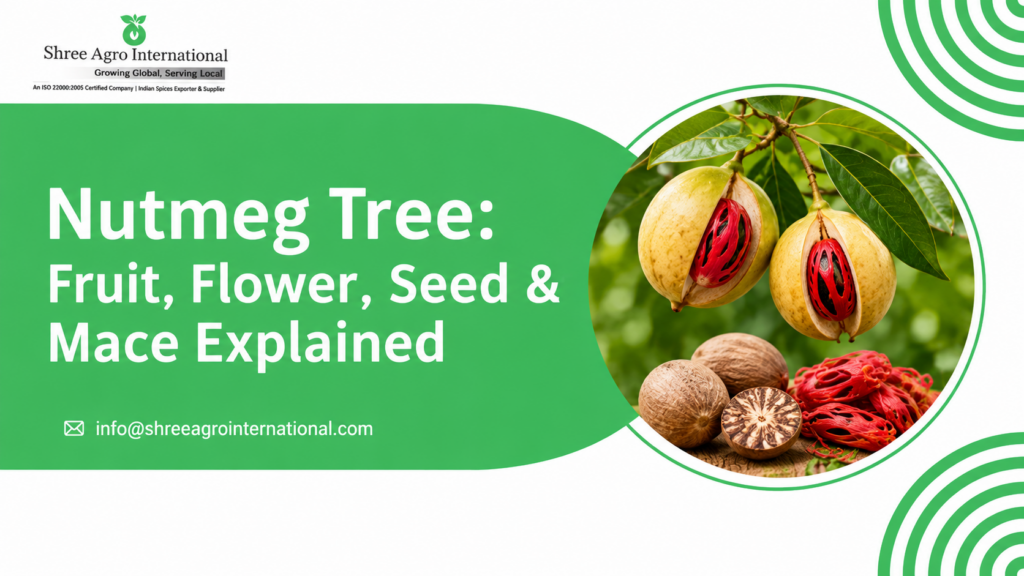
The nutmeg tree (Myristica fragrans) is a tropical evergreen that gives the spice trade two products from one fruit: nutmeg, the dried kernel of the seed, and mace, the dried red aril wrapped around it. The tree is native to the Moluccas in Indonesia, and in India it is grown almost entirely in Kerala.
Most pages about the nutmeg plant are written for gardeners. This one is written from an exporter’s desk. We explain each part of the plant, how the fruit is harvested and dried, and why those farm-level steps decide the quality of the whole nutmeg we supply in bulk.
What Is the Nutmeg Tree?
The nutmeg tree is an evergreen tropical tree of the Myristicaceae family, botanically named Myristica fragrans Houtt. It bears a yellow, apricot-like fruit that splits open when ripe. Inside sits a single seed covered by a red, lacy aril. The dried kernel of that seed is nutmeg, and the dried aril is mace.
| Detail | Nutmeg tree at a glance |
|---|---|
| Nutmeg scientific name | Myristica fragrans Houtt. |
| Nutmeg family | Myristicaceae |
| Nutmeg origin | Moluccas (Banda Islands), Indonesia |
| Tree type | Evergreen, with separate male and female trees |
| Spices produced | Nutmeg (seed kernel) and mace (aril) |
| Main growing state in India | Kerala, with small areas in Karnataka and Tamil Nadu |
| Indian names | Jaiphal (nutmeg), Javitri or Jaipatri (mace) |
Parts of the Nutmeg Plant and What the Trade Does With Each
Buyers usually see only the brown, wrinkled kernel. The plant offers more than that, and knowing each part helps you read a specification sheet correctly.
Nutmeg fruit
The nutmeg fruit is a fleshy, pale yellow drupe about the size of an apricot. A fresh fruit weighs roughly 60 g, yet the seed inside is only 6–7 g and the mace 3–5 g, according to a NIFTEM processing note on nutmeg. The thick outer rind is not a traded spice. In Kerala it is turned into candy, jam, syrup and pickle rather than thrown away.
Nutmeg flower
The nutmeg flower is small, pale yellow, waxy and bell-shaped. Male and female flowers grow on separate trees, so only female trees carry a crop. Two naming points confuse buyers. In some markets mace is loosely called “nutmeg flower spice” because of its petal-like shape. And “nutmeg flower” is also an old English name for Nigella sativa, a completely different plant that we sell as nigella seed (black cumin). Always confirm the botanical name on the contract.
Aril of nutmeg (mace)
The aril of nutmeg is the bright scarlet, net-like covering over the seed shell. Once peeled off and dried it turns amber to orange-yellow and is sold as mace. It comes from the same fruit but is graded, priced and shipped as a separate spice.
Nutmeg seed and kernel
Under the aril is a hard, glossy, dark brown shell. The kernel inside that shell is the nutmeg of commerce. Lots are traded either “with shell” or “without shell”, and the price difference is large because the shell adds weight but no flavor.
Nutmeg leaf
The nutmeg leaf is dark green, glossy and aromatic when crushed. It has no role in the whole-spice trade, though leaves and other plant parts are sometimes distilled for essential oil.
| Part of the fruit | What it becomes | Relevance for a spice buyer |
|---|---|---|
| Rind (pericarp) | Candy, jam, syrup, pickle | Local by-product, not an export spice |
| Aril | Mace (Javitri) | Separate spice with its own specification |
| Seed shell | Removed at cracking | Decides “with shell” vs “without shell” pricing |
| Kernel | Whole nutmeg, ground nutmeg, oil, oleoresin, nutmeg butter | The main traded product |
Where the Nutmeg Tree Grows
The nutmeg plant needs a warm, humid climate, well-spread rainfall, deep well-drained soil and some shade when young. That is why it thrives as an intercrop under coconut and arecanut in Kerala’s river-belt gardens and fails in dry or waterlogged land.
Kerala dominates nutmeg in India. Spices Board material puts the state at about 18,000 MT, close to 95% of national production (Spices Board India, 2026). Government second advance estimates for 2025-26 show roughly 25,500 hectares under the crop in Kerala. Globally, Indonesia remains the reference origin, with Grenada, Sri Lanka and India as other established sources.
For a buyer, this concentration matters. One state, one monsoon and one harvest window drive availability and price for Indian nutmeg each year. We covered that seasonal pattern in our post on why Indian nutmeg demand rises after the monsoon.
From Planting to First Harvest: A Slow Crop
Nutmeg rewards patience. Three biological facts explain why supply cannot respond quickly to price.
- Half the seedlings may be male. Trees raised from seed split into male and female plants, and ICAR-IISR guidance notes that around 50% can turn out to be unproductive males. Growers now prefer grafts taken from proven female trees.
- Bearing starts late. A tree takes around seven to eight years to give a meaningful crop. The ICAR-IISR variety Viswashree yields about 1,000 fruits per tree by the eighth year.
- Trees stay productive for decades. A well-kept orchard keeps bearing for generations, so quality depends more on harvest and drying discipline than on replanting.
How Nutmeg Is Harvested and Dried
This is the stage where good nutmeg is made or spoiled. Fruits are ready when the rind splits on the tree and the red aril shows through. Farmers pick the split fruits or collect them soon after they drop.
- De-rinding. The fleshy rind is removed the same day.
- Separating the mace. The aril is peeled off by hand, flattened and dried separately.
- Drying the seed in its shell. Seeds are dried slowly until the kernel shrinks and rattles inside the shell when shaken. That rattle is the farmer’s traditional dryness test.
- Cracking and sorting. Shells are cracked, and kernels are sorted by size and soundness. Shriveled, broken and insect-damaged pieces are removed.
Why the nutmeg dryer matters in Kerala
In Kerala the main harvest falls in the monsoon, so open sun drying is often impossible. ICAR researchers describe farmers relying on firewood-heated drying rooms and, increasingly, mechanical and solar tunnel dryers (ICAR-IISR, Indian Horticulture, 2025). In ICAR-IISR trials, a solar tunnel dryer took 147 hours to finish a batch, while a mechanical nutmeg dryer took 78 to 105 hours at 45–55°C.
Speed and temperature both matter. Dry too slowly in humid weather and mold sets in. Dry too hot and the fat-rich kernel loses volatile oil and aroma. Either fault shows up later in a laboratory report.
Fresh Nutmeg vs Dried Nutmeg
Fresh nutmeg straight from the fruit is soft, heavy with moisture and unfit for shipping. Dried nutmeg is the stable, hard kernel the world trades. Seeds lose about a quarter of their weight during drying, which is one reason properly dried lots cost more per kilogram than under-dried ones.
Whole nutmeg holds its volatile oil far longer than powder. Food manufacturers who need consistency often buy whole kernels and grind close to use, while others prefer ready nutmeg powder milled to a set mesh size. Freshly ground nutmeg and grated nutmeg in a kitchen follow the same logic on a smaller scale.
What the Tree Tells a Buyer: Farm Step to Specification
Every line on a nutmeg specification traces back to something that happened on the tree or in the dryer. The table below links the two. Limits shown are regulatory references, not our guaranteed values.
| Farm or processing step | What goes wrong | Where it shows on the COA | Reference limit |
|---|---|---|---|
| Fruits left on wet ground | Mold growth on the seed | Aflatoxins, ochratoxin A | EU: aflatoxin B1 5.0 µg/kg, total aflatoxins 10.0 µg/kg, ochratoxin A 15 µg/kg |
| Incomplete drying | High moisture, mold in transit | Moisture | FSSAI: 10% max (whole), 8% max (powder) |
| Overheated drying | Loss of aroma | Volatile oil | FSSAI: 6.5% min (whole), 6.0% min (powder) |
| Poor sorting after cracking | Shriveled, broken or insect-damaged kernels | Purity, extraneous matter, insect damage | As per buyer contract |
| Dusty or soiled handling | Dirt carried into the lot | Total ash, acid-insoluble ash | FSSAI: 3.0% and 0.5% max |
The EU figures come from Commission Regulation (EU) 2023/915, which names nutmeg specifically in its mycotoxin entries. Nutmeg is one of the spices where aflatoxin control is won or lost at the farm, not in the factory.
Six questions to ask a nutmeg supplier
- Which growing region and crop year is the lot from?
- Was it dried in the sun, a firewood dryer or a mechanical dryer?
- Is the offer with shell or without shell, and what is the size sorting?
- What are the moisture and volatile oil values on the latest COA?
- Is there a recent aflatoxin and ochratoxin A report from an accredited lab?
- How is the lot stored and packed before stuffing the container?
Storage is the last link. A well-dried kernel can still pick up moisture in a humid warehouse, which we explain in our guide to nutmeg storage during the rainy season.
How Shree Agro International Handles Nutmeg
Shree Agro International has exported spices and oil seeds from Unjha, Gujarat since 1988 and is a Government of India–recognized Three Star Export House shipping to 40+ countries. Nutmeg does not grow in Gujarat. We procure it from India’s growing regions [CLIENT INPUT: confirm nutmeg sourcing region(s), e.g. Kerala] and machine-clean, grade and pack it at our audited unit in Unjha.
- Organic, IPM and conventional nutmeg, machine cleaned to 99% purity with 10% maximum moisture.
- In-house QC lab, with third-party lab testing and inspection on request. See our quality control process.
- Certifications including BRC Food Safety, USDA Organic, EU Organic, HACCP, ISO 22000, Kosher and Halal.
- PP, paper and jute bag options, plus private label and custom packaging.
Frequently Asked Questions
How long does a nutmeg tree take to bear fruit?
A nutmeg tree usually takes around seven to eight years to give a meaningful crop. The ICAR-IISR variety Viswashree yields about 1,000 fruits per tree by the eighth year. Yields keep rising for many years after that, and a healthy tree stays productive for decades, which is why orchards are treated as long-term assets.
Is nutmeg a fruit, a nut or a seed?
Nutmeg is a seed, not a true nut. The nutmeg fruit is a fleshy yellow drupe that splits open when ripe. Inside is one seed with a hard shell. The kernel inside that shell, once dried, is the spice sold as nutmeg. The red covering over the shell becomes mace.
What is the difference between nutmeg and mace?
Both come from the same fruit of Myristica fragrans. Nutmeg is the dried kernel of the seed. Mace is the dried aril, the red lacy layer around the seed shell. They share a similar warm flavor, but they are dried, graded, priced and shipped as two separate spices with separate specifications.
Can you eat nutmeg fruit?
The fleshy rind of the nutmeg fruit is edible after processing. In Kerala it is commonly made into candy, jam, syrup and pickle. It is sour and astringent when raw, so it is rarely eaten fresh. The rind is a local by-product and is not part of the international whole-spice trade.
Where does nutmeg grow in India?
Kerala grows nearly all of India’s nutmeg, about 18,000 MT or close to 95% of national production according to Spices Board India material. Smaller areas exist in Karnataka and Tamil Nadu. The tree is usually grown as a shaded intercrop in coconut and arecanut gardens in warm, humid, high-rainfall zones.
Why is dried nutmeg sold with shell and without shell?
Seeds are dried inside their shell, which protects the kernel during drying and storage. Some buyers take shelled-on lots and crack them later. Most food buyers want kernels without shell, already sorted for size and soundness. The shell adds weight but no flavor, so shelled kernels carry a higher price per kilogram.
How can I check if whole nutmeg is properly dried?
For shell-on nutmeg, the kernel should rattle when the seed is shaken. For shelled kernels, rely on the certificate of analysis. FSSAI sets a 10% maximum moisture for whole nutmeg, and buyers shipping to the EU should also ask for aflatoxin and ochratoxin A results from an accredited laboratory.
Request Nutmeg Specifications and a Quote
Need whole nutmeg or nutmeg powder for your market? Send us your grade, volume, certification and packaging requirements, and we will share a specification sheet, COA format and price. Contact Shree Agro International at info@shreeagrointernational.com or +91 96388 25444.
