


India doesn’t win the pepper trade on volume and it’s stopped trying to. Vietnam grows more than a third of the world’s supply and exports nearly all of it, undercutting almost anyone on price. India, ranked a distant second globally, has instead built its entire pepper export strategy around something Vietnam can’t easily copy: Geographical Indication-protected Malabar quality, premium visual grading, and a processing industry that turns raw pepper into high-margin oleoresins and extracts.
That strategy is exactly why “Indian black pepper export demand” looks so different depending on which grade or format you’re talking about. Here’s the full picture current numbers, who’s buying, why India competes on quality instead of price, and where this market is headed.
Current Export Volume and Value
Black pepper contributes roughly 3% of India’s total spice export value as a raw commodity, generating between $133 million and $200 million annually depending on crop yields and global pricing. That’s a modest slice on its own, but the picture changes dramatically once you factor in spice oils and oleoresins the processed derivatives built largely on pepper and other spices which add another $498–535 million, or about 12% of total spice export value.
India’s overall spice trade set an all-time high in FY 2024–25, shipping 17.99 lakh tonnes worth $4.72 billion, before a cyclical pullback to $4.43 billion across 17.34 lakh tonnes in FY 2025–26. That contraction wasn’t unique to pepper it reflected broader currency realignment and global demand shifts across the whole spice basket, not a loss of competitiveness in any single category.
Where Malabar Pepper’s Quality Actually Comes From
Global black pepper production sits between 550,000 and 600,000 metric tons a year, and India contributes about 13.5% of that as the world’s second-largest producer behind Vietnam, ahead of Indonesia and Brazil. Indian output has grown steadily too, climbing from 104,000 MT in 2020 to 126,038 MT in 2024, a 21% increase in five years.
Nearly all of that comes from the Malabar Coast Kerala’s Wayanad, Kannur, Kozhikode, and Idukki districts where deep laterite soil, over 2,000mm of annual monsoon rainfall, and shade-grown cultivation on living support trees combine to produce pepper with genuinely distinctive flavor chemistry. More than 95% of this cultivation happens on smallholder plots, and it’s protected under the Malabar Pepper Geographical Indication tag registered with the Spices Board in 2008 a legal quality marker Vietnam’s unshaded monoculture plantations simply don’t have access to.
How Grading Actually Drives the Price You Pay
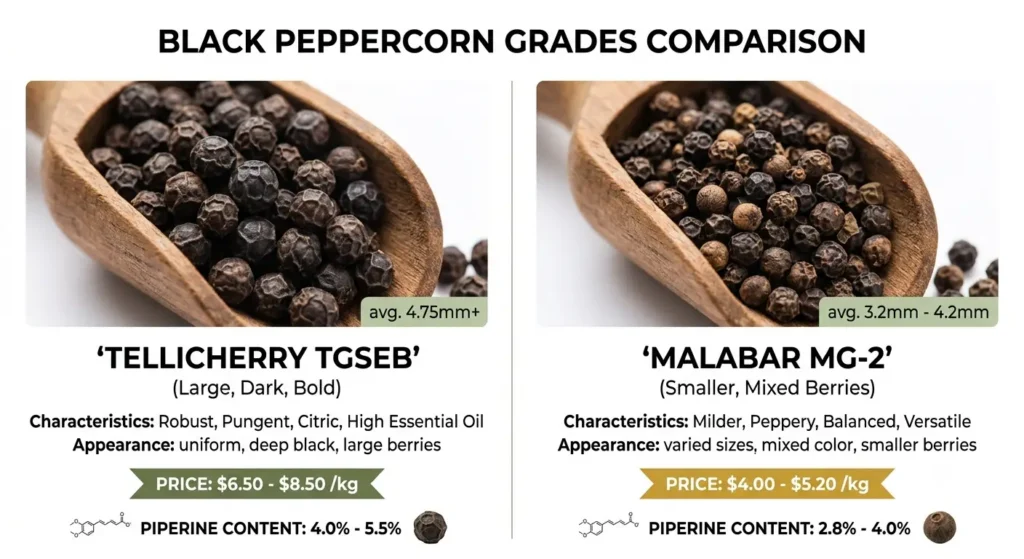
Commercial pepper grades split into two families: Malabar and Tellicherry. Tellicherry isn’t a separate growing region it’s a size and maturity grade, referring to the largest, latest-harvested berries that develop the fullest aromatic complexity. At the top end, Tellicherry Garbled Special Extra Bold (TGSEB) 550-580 g/L density, 7-9% piperine content commands $6.50-8.50/kg FOB for gourmet retail and luxury culinary buyers in the US and EU.
Standard Malabar Garbled grades (MG-1, MG-2) run considerably lower, around $4.00-6.00/kg, feeding industrial food manufacturing and ground pepper production instead. USDA/EU-certified organic lots sit at the very top of the range, $7.00-10.00/kg, serving health-food retail and organic-certified processors. That’s roughly a 2.5x price spread between the lowest and highest grades of the exact same crop which is precisely why grading discipline matters more in pepper than in almost any other spice category.
Who’s Actually Buying Indian Pepper
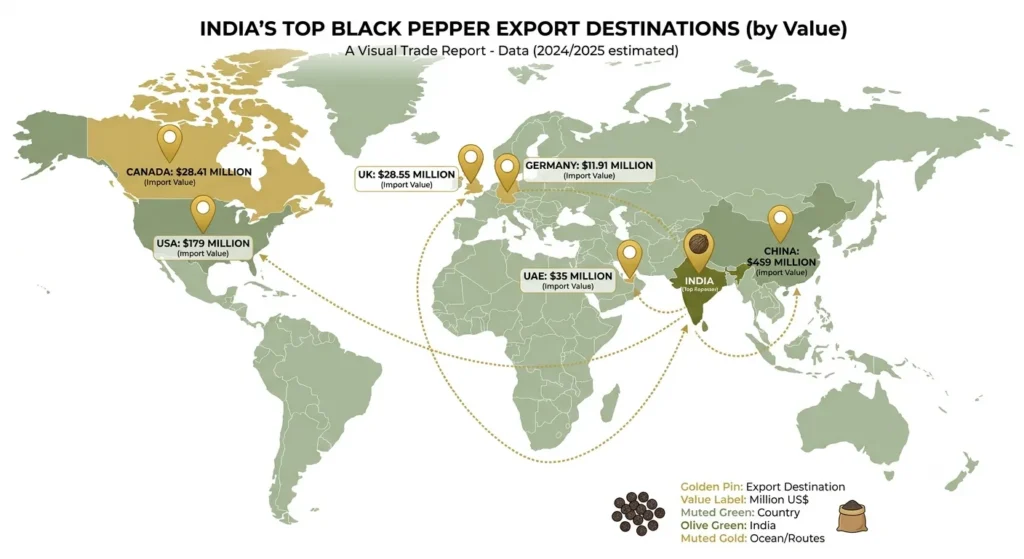
The United States is India’s single largest destination, importing over $580 million annually in black pepper and derivatives combined, driven by food processing, expanding nutraceutical demand for high-piperine extracts, and restaurant chains. China follows closely, importing largely for its own extraction and re-processing industry rather than direct consumption.
The UAE serves as a regional re-export hub for the broader Middle East, while the UK, Germany, and Canada round out the top six each with a distinct demand profile. Germany in particular acts as the primary clearinghouse for EU distribution, and its buyers enforce some of the strictest residue and organic-certification standards in the entire import chain, making steam-sterilized and certified-organic batches essentially mandatory for clearing German ports.
Why India Competes on Quality, Not Volume
India’s domestic market actually consumes 70-80% of its own spice output a structural advantage most people miss. That internal demand creates a price floor that buffers Indian growers against the kind of severe global price crashes that hit purely export-dependent, volume-focused producers like Vietnam much harder. It’s also exactly why India can afford to specialize in high-margin visual grades instead of racing Vietnam to the bottom on price.
This plays out as a genuine dual-track export model. One track sends premium GI-protected Tellicherry and Malabar grades to Western retail and specialty food service at top pricing. The other track runs through India’s extraction industry, where processors including major names like Synthite Industries and Plant Lipids convert both domestic and duty-free imported raw pepper into oleoresins, essential oils, and purified piperine extracts under the government’s Advance Authorization Scheme, preserving strong margins regardless of what raw commodity prices are doing globally.
India vs Vietnam, Indonesia, and Brazil: The Real Competitive Picture
Put the four major origins side by side and the strategy differences become obvious. Vietnam produces over a third of global supply and exports upward of 95% of its harvest, competing almost entirely on price and volume with limited grade differentiation. Indonesia and Brazil sit further down the production ranking, generally supplying commodity-grade pepper into industrial food manufacturing and extraction markets with little of the branding or certification infrastructure India has built.
India, by contrast, exports a much smaller share of what it grows because 70-80% of domestic output stays in the local market but what does leave the country skews heavily toward the premium end: GI-tagged, organic-certified, high-piperine grades that fetch genuinely different pricing than anything Vietnam typically ships. The practical upshot for buyers is straightforward: if landed cost per kilogram is the only variable that matters, Vietnam or Brazil usually wins. If piperine concentration, aroma complexity, traceability, or organic certification matter to the end product, Indian Malabar and Tellicherry grades are usually worth the premium.
The Container Economics
A standard 20-foot container holds 14-15 metric tons of whole peppercorns, with dense palletizing pushing that up to 22-26 MT. A full 15 MT shipment of standard Malabar Garbled pepper typically lands buyers $74,300-82,000 in total CIF cost once sourcing, processing, freight, and compliance testing are factored in. Well-positioned exporters working the premium end of the grade spectrum report net margins of $15,000-25,000 per container a meaningful spread that again comes down almost entirely to grade selection.
Compliance Is Now a Filter, Not a Formality
Out of roughly 60,000 exporters registered with the Spices Board, only about 200 fully meet the traceability, lab-testing, and sanitary standards that high-value international buyers now demand. The EU and US maintain near-zero-tolerance policies on Ethylene Oxide residues, pushing exporters toward continuous steam-sterilization infrastructure, while European regulators also track Mineral Oil Aromatic Hydrocarbon limits to prevent contamination from drying tarps and packaging.
Exporters need a working stack of credentials to even compete at this level DGFT Importer Exporter Code, Spices Board Certificate of Registration as Exporter, FSSAI Central License, and RCMC and shipments must clear ASTA cleanliness thresholds on extraneous matter, light berries, and moisture. According to the Spices Board of India’s official trade statistics, this compliance gap is exactly what separates the roughly 200 elite exporters from the broader field of registered traders.
Government Support Is Actively Closing the Gap
The Spices Board’s SPICED scheme Sustainability in Spice Sector through Progressive, Innovative, and Collaborative Interventions for Export Development runs on a ₹422.30 crore outlay through FY 2026-27, funding mechanical threshers, bio-wash units, modern dryers, and steam sterilization equipment for farmer producer organizations and smaller exporters. As confirmed in an official government press release, this scheme is specifically designed to boost both spice export quality and cardamom productivity nationwide.
Alongside SPICED, the Spices Parks network provides shared industrial cleaning, grading, and cold storage infrastructure in major growing clusters, while the Advance Authorization Scheme lets extraction companies import lower-cost raw pepper duty-free specifically for re-export after processing. Together, these programs are narrowing the gap between smallholder-level production and the strict international standards buyers now expect as baseline.
Outlook for the Coming Season
India’s long-term targets are ambitious $10 billion in total spice exports by 2030, scaling to $25 billion across 2.7 million tonnes by 2047 and pepper’s role in that growth depends on continued investment in processing capacity and certification rather than chasing Vietnam on raw volume. The near-term picture points toward continued price stability on premium grades, supported by steady Western demand for GI-certified and organic pepper, even as broader commodity-level export value fluctuates year to year.
The structural advantages are already in place: a domestic consumption base that cushions global price shocks, a genuine two-track model splitting premium whole-berry exports from high-margin extraction, and government schemes actively funding the infrastructure needed to meet tightening international compliance standards. For more on how this fits into India’s broader spice trade, see the full spice-wise export demand breakdown and the complete Indian spices export guide for 2026.
