


What You Will Learn from This Guide:
- IPM & Sustainable Farming Practices: Why Integrated Pest Management (IPM) and organic spice clusters are critical to overcoming international trade rejections .
- Spice-wise Global Demand Analysis: Deep dive into the market trends, quality parameters (like Curcumin and Piperine percentages), and prices for major drivers like Cumin (Jeera), Red Chilli, Turmeric, Cloves, and Ginger.
- Geographical Sourcing Hubs: Exploring India’s climate zones, leading exporter states like Gujarat, Madhya Pradesh, and Andhra Pradesh, and the infrastructure of specialized Spices Parks.
- Global Market Restrictions & Tariffs: A tactical understanding of the current geopolitical risks, Red Sea shipping crises, and compliance checks at Border Control Posts (BCPs).
- Import Dynamics & Value-Add Markets: Understanding why the world’s largest producer also imports specific raw materials (like Cloves and Cassia) to fuel high-margin Spice Oils and Oleoresins segments.
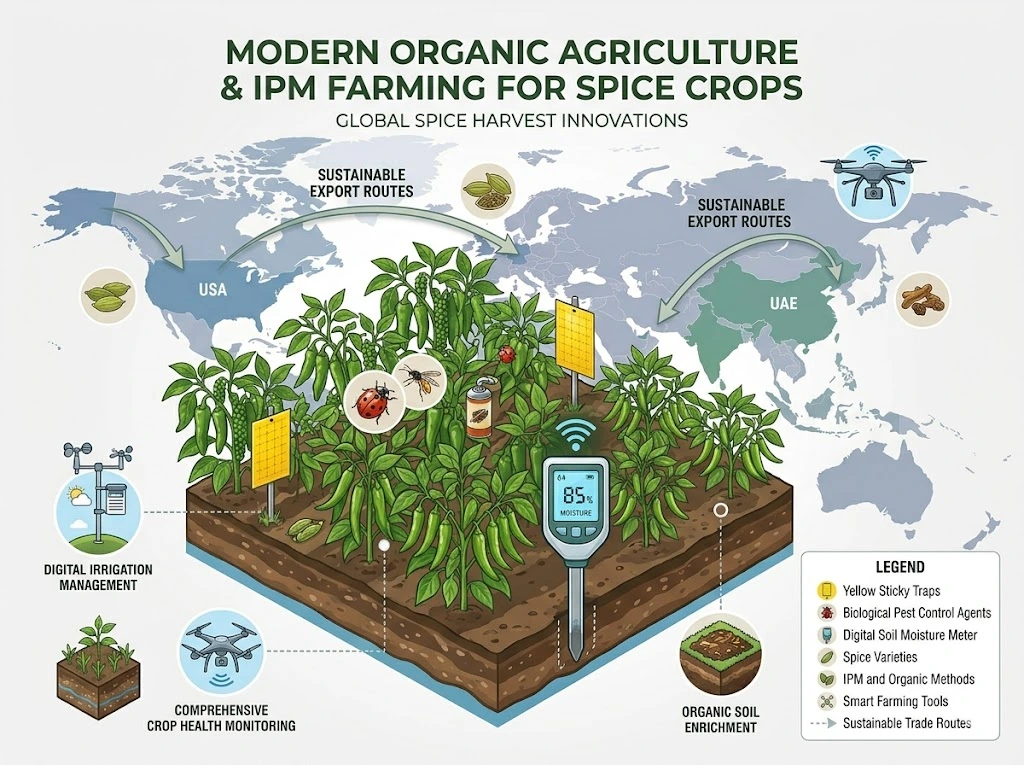
IPM and Farming Methods for Indian Spices
International spice markets have transitioned from simple quality checks to stringent food safety compliance. For modern spice exporters, understanding the shift towards sustainable agriculture is no longer optional – it is a critical business prerequisite to avoid costly international rejections .The Shift from Conventional to IPM and Organic Sourcing
Traditionally, conventional farming relied heavily on chemical pesticides to boost yields. However, global incidents involving Ethylene Oxide (ETO) residues in premium spice mixes [10] and sudden regulatory enforcement—such as the UK Regulation 2025 No.1162 mandating 20% to 50% stricter pesticide clearance checks at Border Control Posts (BCPs) – have disrupted traditional supply chains. To maintain market access in high-value regions like the European Union, USA, and Great Britain, the industry is rapidly moving toward two major frameworks:- IPM (Integrated Pest Management): A holistic approach that combines biological, cultural, and mechanical practices to control pests, using chemical interventions only as a last resort. This guarantees that chemical residues remain well below the Maximum Residue Limits (MRL) required by international food safety authorities.
- Certified Organic Farming: Complete elimination of synthetic chemicals. To cement its position, India has developed 28 dedicated organic spice clusters, successfully certifying over 34,000 metric tons of completely chemical-free spices tailored for eco-conscious Western buyers.
Strategic Government Initiatives: The SPICED Scheme
To aggressively back this transition, the Spices Board of India has launched the proactive SPICED (Sustainability in Spice Cultivation for Export Advancement and Diversification) Scheme. This national initiative provides direct financial incentives and technical infrastructure to farmers and exporters for upgrading technology, adopting pesticide-free sustainable farming, and achieving international organic certifications.|
Nutrient / Protection Parameter |
Recommended Input & Treatment Dosage | Frequency and Precision Timing |
|
Organic Soil Amendment |
10 kg FYM + 1 kg Neem Cake per vine | Annually in May–June (Pre-monsoon) |
|
Bio-fertilizer Consortium |
50 g Azospirillum + 50 g Phosphobacteria per vine |
Annually from the 3rd year onwards |
|
Biological Antagonists |
50 g T. harzianum + 50 g P. fluorescens per vine |
Twice annually (May–June & Aug–Sept) |
|
Systemic Fungicidal Drench |
Potassium Phosphonate (Akomin) @ 3 to 5 mL/L |
Target root zone drenching in June and August |
|
Contact Canopy Spray |
Bordeaux Mixture @ 1.0% concentration |
Foliar spray pre-monsoon (June) and post-monsoon (August) |
|
Anthracnose Control |
Propiconazole 25 EC (0.1%) or Carbendazim-Mancozeb (0.2%) |
Alternated foliar canopy sprays in late May and August |
| Sucking Pest / Root Mealybug |
Flonicamid @ 0.3 g/L or Buprofezin @ 3 mL/L |
Soil basin drenching immediately upon pest detection |
Spice-wise Export Demand & Global Dynamics
The global spice trade is heavily driven by a concentrated group of high-performance commodities. A microscopic analysis of current trade volumes reveals that just five key spices- Red Chilli, Cumin, Turmeric, Ginger, and Coriander – collectively command approximately 75% of India’s total spice export volume. To remain cost-competitive against ASEAN competitors like Vietnam and Indonesia, especially under shifting trade policies and flat 25% to 26% US import tariffs, modern exporters must look beyond mere weight and analyze product-specific chemical parameters and geopolitical buyer intent.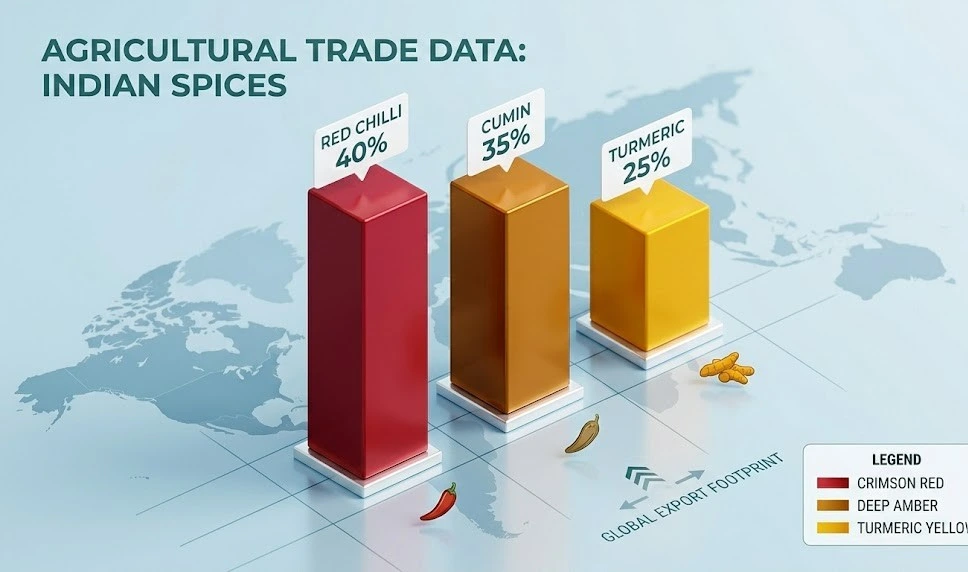
Commodity Export Performance Overview
The commercial traction of India’s leading export-oriented spices highlights major value shifts across consecutive financial years:|
Spice Category |
Export Value FY 2023-24 (USD Million) | Export Value FY 2024-25 (USD Million) | Year-on-Year Value Growth (%) | Export Volume FY 2024-25 (Million Tonnes) |
Core Quality Determinants & Market Drivers |
|
Red Chilli |
$1,508.94 | $1,340.00 | -11.0% | 0.71 |
ASTA Color Value & Scoville Heat Units (SHU). Volume leader (31% of total export value) . Driven by China’s extraction industries. |
|
Cumin (Jeera) |
$700.23 | $732.35 | +4.6% | 0.22 |
Volatile Essential Oil Density. Prices closely dictated by Asia’s largest trading hub in Unjha. |
|
Spice Oils & Oleoresins |
$498.01 | $535.92 | +7.6% | – |
Bioactive Compound Purity. Premium margin segment serving global pharma and cosmetic sectors. |
|
Turmeric (Haldi) |
$225.80 | $341.00 | +51.0% | 0.17 |
Curcumin Percentage. Explosive growth driven by global health/nutraceutical demand. |
|
Ginger |
$112.50 | $130.00 | +15.0% | 0.13 |
Gingermint Aroma / Moisture Profile. Exported largely in crushed and dry formats. |
Storage & Post-Harvest Handling
Maintaining structural and chemical integrity during post-harvest storage is crucial for volatile agro-commodities. Spices are inherently hygroscopic (moisture-absorbing) biological materials containing fragile organic structures, including volatile essential oils, natural pigments, and active flavor compounds that rapidly degrade under adverse conditions.Spice Storage Challenges During Monsoon (The Science of Moisture)
During the monsoon season, the ambient Relative Humidity (RH) routinely surges above 90%, especially across coastal and major spice-growing tropical belts.- Hygroscopic Risks & Microbial Growth: For baseline safety, high-grade spices must be dried to a secure internal moisture threshold of approximately 10%. If ambient storage environments exceed 65% RH, spices actively absorb atmospheric water, causing physical clumping. This elevated water activity triggers rapid microbial contamination, making mold safety a prime operational concern.
- Volatile Oil & Flavor Loss: Elevated heat and humidity catalyze the evaporation of volatile essential oils, stripping the spice of its characteristic aroma and pungent profile.
- Color Fading & Photo-Oxidation: Exposure to moisture and ultraviolet (UV) rays fractures sensitive natural pigments, leading to rapid color fading in premium products like turmeric and red chilli.
- Powder Vulnerability: Ground spices (powders) feature a vastly expanded surface area compared to whole variants, accelerating kinetic moisture absorption and chemical oxidation.

1. Crucial Parameters for Spice Storage During Monsoon
To mitigate seasonal risks, intermediate and bulk warehouses must implement strict climate controls. Effective management mandates keeping indoor humidity strictly within a 55% to 65% RH window. Operational facilities utilize continuous humidity monitoring, mechanical dehumidifiers, and hermetically sealed environments. Furthermore, intense-aroma products (e.g., garlic powder or asafoetida) must be compartmentalized in isolated chambers to prevent cross-contamination of delicate surrounding stock. For target crops requiring distinct moisture protocols, explore our technical guide on Nutmeg storage rainy season.2. How to Preserve Spice Oil Content
The market value of premium spices relies directly on preserving volatile compounds (such as piperine in black pepper or curcumin in turmeric). To insulate these volatile essential oils from chemical evaporation and degradation, inventory must be stored in oxygen-barrier, non-porous containers (such as food-grade laminated foils, dense glass, or stainless steel bins). Stock must be kept completely away from processing heat and steam in a cool, stabilized thermal zone.3. Export Quality Storage Standards (Phytosanitary & Logistics)
To pass strict global border checks (such as the UK Regulation 2025 No.1162 or EU MRL rules), raw materials must never undergo open-yard drying on soil, which introduces environmental dust and carcinogenic aflatoxins. Commercial exporters must utilize automated processing parks for climate-controlled, uniform steam-sterilization and rapid moisture reduction. Every storage batch requires transparent, documented end-to-end traceability links mapping back to specific farm clusters to verify compliance.Global Market & Buyer Intent
Sourcing from India requires clear visibility into dynamic geographic consumption shifts, rigorous certification tracks, and strategic processing infrastructures. To successfully target global buyers, an exporter must align supply chain capabilities with international trade compliance and regional specialties .1. Top Countries Importing Indian Spices
Global buyer intent is highly regionalized, driven by distinct culinary and industrial processing demands.- China ($768.50 Million): Currently India’s largest volume buyer.The primary commercial focus is dried red chillies, which feed massive Chinese domestic food extraction and sauce manufacturing industries.
- United States ($654.71 Million): Operates as a premium destination market showing a 15% year-on-year growth. US buyers systematically look for clean-label, high-specification whole spices, and value-added extractions like spice oils and oleoresins for the cosmetic and pharmaceutical sectors .
- United Arab Emirates ($355.41 Million): Serves as the primary logistics gateway and re-export hub for the entire Gulf Cooperation Council (GCC) and North African trading zones.
2.Export Documentation & Compliance for Spices India
Clearing global borders safely requires automated verification over phytosanitary and chemical parameters. The standard mandatory compliance pipeline involves:- CRES & Sourcing Registration: Exporters must register via the official Spices Board portal to secure a Certificate of Registration as Exporter of Spices (CRES).
- Target-Market Lab Screenings: Consignments undergo strict analytical checks prior to custom clearances to verify purity. For instance, shipments to the EU face high inspection frequencies for Aflatoxins and Ochratoxin A, while Japan mandates strict pesticide evaluations for Cumin and Chilli.Sugar-coated fennel is checked for illegal synthetic colors, and bulk Cumin is screened to eliminate extraneous matter and competitive weed seeds .
3. How Indian Spices Reach Global Markets (Infrastructure & Value)
India’s supply chain channels raw materials away from traditional open-yard risks through specialized physical processing nodes and legal origin certifications.A. Centralized Primary Processing: Spices Board Spices Parks
To eliminate intermediate logistical gaps and contamination risks (like dust or natural toxins), the Spices Board of India utilizes state-of-the-art Spices Parks located directly in major growing hubs. These establish direct, documented links between farming clusters and processing facilities for complete end-to-end traceability.|
Spices Park Name |
State Location | Primary Target Commodities | Processing Technologies Provided |
|
Chhindwara |
Madhya Pradesh | Garlic, Red Chilli |
Automated sorting, grading, slicing, dehydrating. |
|
Guna |
Madhya Pradesh | Coriander | Stem-separation, gravity-grading, Sortex cleaning. |
|
Guntur |
Andhra Pradesh | Red Chilli |
De-stemming, uniform drying, mechanical grinding. |
|
Jodhpur |
Rajasthan | Cumin, Fennel |
Seed-cleaning, desanding, magnetic separation. |
|
Puttady |
Kerala | Cardamom, Black Pepper |
E-auction center, mechanical washing, moisture curing. |
| Sivaganga | Tamil Nadu | Chilli, Turmeric |
Boiling, polishing, steam-steriliza |
