


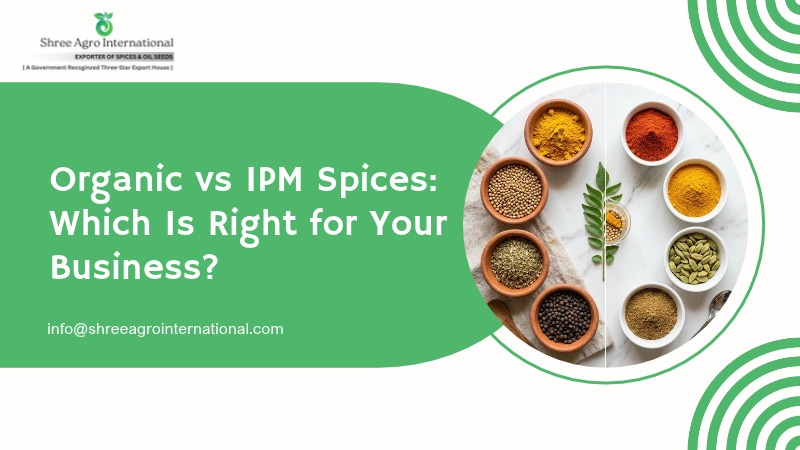
When a new buyer calls us from Europe or the USA, one question comes up almost every time – “Should we buy organic spices or IPM spices?” Both are good options. Both are safer than normal spices grown with heavy chemicals. But they are not the same, and the right choice depends on your customers, your market and your budget. In this blog, we explain the difference in very simple words, so you can take the right decision for your business.
1. What Are Organic Spices?
Organic spices are grown without any chemical pesticides, chemical fertilisers or GMO seeds. Farmers use natural methods like cow dung manure, compost, neem-based sprays and crop rotation.
A farm cannot become organic overnight. The land must go through a conversion period (usually 2 to 3 years) where no chemicals are used. After that, a certification body checks the farm, the processing unit and the records every year.
Common organic certificates for spices from India:
- NPOP – India’s National Programme for Organic Production
- USDA NOP – needed for selling as organic in the USA
- EU Organic – needed for selling as organic in the European Union
Only spices with a valid certificate and a Transaction Certificate (TC) for each shipment can be sold with the organic label.
2. What Are IPM Spices?
IPM means Integrated Pest Management. It is a smart and balanced way of farming. Farmers first use natural methods to control pests – like traps, good seeds, crop rotation and helpful insects. Chemical pesticides are used only when really needed, in the right dose and at the right time.
Because of this careful use, IPM spices have very low pesticide residue, usually within the strict MRL (Maximum Residue Limit) of the EU and USA. IPM spices are not “organic”, but they are cleaner and safer than normal conventional spices.
3. Organic vs IPM: Side-by-Side Comparison
Here is a simple table to understand the main difference:
| Point | Organic Spices | IPM Spices |
|---|---|---|
| Chemical use | No chemical pesticides or fertilisers | Minimum, need-based use only |
| Certification | NPOP / USDA NOP / EU Organic required | No organic label; quality proven by lab reports |
| Price | Higher (premium price) | Moderate, closer to conventional |
| Supply volume | Limited, depends on certified farms | Larger and more stable |
| Pesticide residue | Should be nil or near nil | Low, within EU/US MRL |
| Label on pack | Can print “Organic” with logo | Cannot use “Organic” word |
| Paperwork | More (TC, farm records, audits) | Less (COA and residue reports) |
| Best for | Organic brands, health stores, premium retail | Food factories, wholesalers, private labels |
4. Which Option Suits Which Buyer?
Choose Organic Spices if:
- You sell in organic shops, health food stores or online organic platforms
- Your brand promise is “100% natural” or “chemical-free”
- Your customers are ready to pay a premium price
- You want to print the organic logo on your packets
Choose IPM Spices if:
- You supply to food processing units, restaurants or spice blenders
- You need large and regular volumes at a stable price
- Your main need is “low residue and EU/US compliant”, not the organic label
- You are working on tight margins but still want safe, clean spices
Many of our buyers actually do both. They buy organic for their premium retail range and IPM for their bulk and food-service range. This mix gives them better margins and steady supply.
5. How to Decide: Step-by-Step Process
Follow these simple steps before you place your order:
- Know your end customer – Are they asking for the organic label, or only for safe, tested spices?
- Check your market rules – Each country has its own organic standard. For example, the USA needs USDA NOP and the EU needs EU Organic certification.
- Calculate your budget – Compare organic and IPM prices for your spice and see which one fits your selling price.
- Check supply needs – If you need large monthly volumes, confirm the exporter can supply organic stock regularly.
- Ask for samples and reports – Take samples of both and check aroma, colour, purity and lab reports.
- Verify documents – For organic, check the certificate on the certifier’s website and ask for a TC. For IPM, ask for a fresh pesticide residue report.
- Start with a trial order – Begin small, check the market response, then scale up.
6. Do’s and Don’ts
✔ Do’s
- Match your choice to your customer’s real need
- Check organic certificates for validity and scope
- Ask for a Transaction Certificate for every organic lot
- Get lab residue tests for both organic and IPM spices
- Work with an exporter who handles both options
✘ Don’ts
- Don’t sell IPM spices with an “Organic” label
- Don’t assume organic means no testing is needed
- Don’t accept organic claims without valid certificates
- Don’t choose organic only for marketing if buyers won’t pay the premium
- Don’t ignore your country’s specific organic rules
7. Frequently Asked Questions (FAQs)
Are IPM spices safe to eat?
Yes. IPM spices are grown with very limited and controlled pesticide use. Their residue is tested and kept within the limits set by countries like the EU and USA.
Why are organic spices more costly?
Organic farming gives lower yield, needs more manual work, and has extra costs for certification, audits and separate storage. That is why the price is higher.
Can I print “Organic” on IPM spice packets?
No. Only certified organic products with valid documents can use the word “Organic”. Using it on IPM spices is against the law in most countries.
Do organic spices also need lab testing?
Yes. Organic spices are also tested for pesticide residue, aflatoxin and bacteria. Buyers check organic lots even more carefully.
Which option is better for private label brands?
It depends on your brand. If your brand is premium and health-focused, choose organic. If you want good quality at a competitive price, IPM is a smart choice.
Need organic or IPM spices from India?
Shree Agro International supplies certified organic, IPM and conventional spices and oil seeds to buyers in 40+ countries. Contact our team today for samples, prices and certificates.
