


Mustard powder looks like the simplest ingredient in your spice cabinet a fine, pale powder ground from a small round seed. In reality, it’s one of the most chemically complex spices you’ll ever procure, built on a precise enzyme reaction that determines whether your finished product tastes sharp and nose-clearing or mild and lingering. Get the species, processing, or storage wrong, and you don’t just lose flavor you can end up with an off-spec batch that fails a customer’s sensory panel entirely.
This guide covers what mustard powder actually is, the real differences between yellow, brown, and black mustard, the chemistry that controls its heat, and the export specifications serious buyers need to check before signing a purchase order.
What Is Mustard Powder? Meaning and Botanical Origins
Mustard powder meaning, in the simplest terms, is the finely ground product made from dried seeds of plants in the Brassicaceae family the same family as cabbage and broccoli. So what is mustard powder made from exactly? It comes from one of three distinct botanical species, and which species was used changes almost everything about the final product’s flavor, heat, and function.
Mustard powder means something different depending on context too in a recipe it usually implies a pungent, ready-to-hydrate flavoring agent, while in industrial food manufacturing it more often refers to a functional ingredient valued for its emulsifying and water-binding properties rather than its heat. Both uses trace back to the same raw material family, just processed and selected for different end goals.
Yellow Mustard Powder (Sinapis alba): Mild Heat, High Functionality
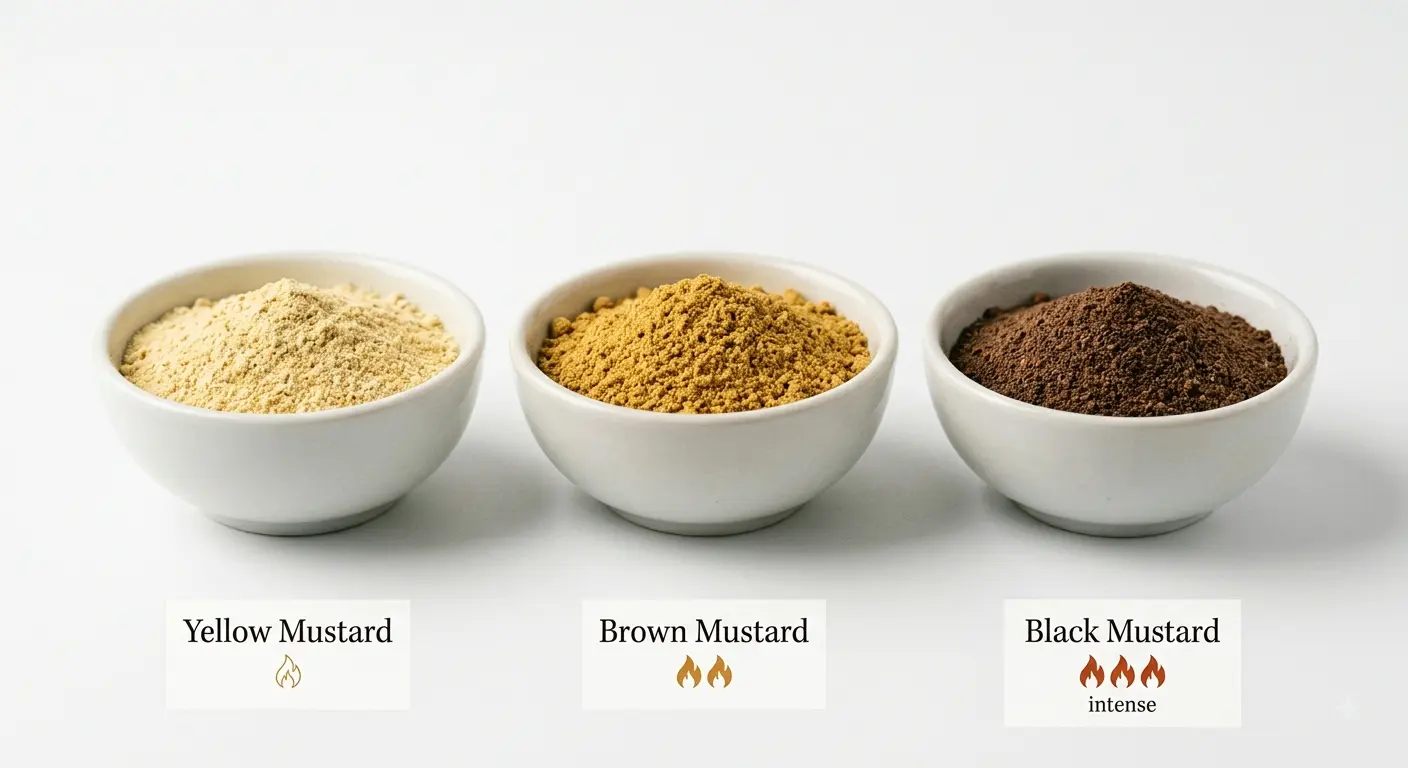
Yellow mustard powder botanically Sinapis alba, sometimes called white mustard comes from large, pale-yellow seeds with a smooth outer coat. Its primary compound, sinalbin, breaks down into a non-volatile isothiocyanate that produces a sharp heat localized on the tongue, without any of the sharp nasal aroma brown or black mustard delivers. That makes it the functional base for American-style salad mustards and mild table condiments.
Beyond flavor, yellow mustard’s outer seed coat carries high mucilage content, giving it genuinely useful water-binding and emulsification properties in processed food. This is exactly why deodorized yellow mustard flour heat-treated to strip out pungency entirely shows up as a functional binder in cured meats and sauces rather than as a flavoring agent at all.
Black Mustard Powder: Intense Heat, Traditional Use
Black mustard powder comes from Brassica nigra, yielding small, dark, pitted seeds with the highest volatile oil content of the three species 0.25% to 1.4%. It contains sinigrin, the same glucosinolate found in brown mustard, which converts to volatile allyl isothiocyanate (AITC) on hydration, delivering the most intense, nose-clearing heat and aroma of any commercial mustard type.
The catch is agronomic, not culinary: Brassica nigra pods shatter easily at maturity, making mechanical harvesting genuinely difficult at commercial scale. That’s why brown mustard (Brassica juncea) has largely replaced it in large-scale farming, even though black mustard remains prized in traditional cooking and specialty spice blending where its intensity is specifically wanted.
Brown or Oriental Mustard: The Commercial Pungency Standard
Sitting between the two, Brassica juncea produces dark reddish-brown to yellow seeds and has become the dominant commercial source for piquant table mustards like Dijon, deli-style mustard, curry powders, and industrial spice blends. Like black mustard, it contains sinigrin and delivers volatile AITC heat but its seed pods hold up to mechanical harvesting far better, making it the practical backbone of most high-pungency industrial supply.
Rai Kuria: Dehusked Split Mustard for Pickling
A specialty intermediate format worth knowing is Rai Kuria dehusked, coarsely cracked yellow or brown mustard seed. Mechanical dehusking removes the bitter outer coat and mucilage layer, leaving golden-yellow cotyledon halves that release oil, pungency, and natural preservative acids gradually into a liquid matrix. That gradual release makes it a staple in Indian pickling achar, methiya, and sambhaar spice blends where whole hull powder would introduce unwanted bitterness and cloudiness.
The Enzyme Chemistry Behind Mustard’s Heat
None of mustard’s pungency exists in the intact seed. Glucosinolates and the enzyme myrosinase sit in separate cellular compartments and only react once milling ruptures the cell walls and water is added myrosinase reaches peak activity within 10 to 15 minutes of hydration, generating maximum heat.
That reaction is fragile in two specific, controllable ways buyers should understand. Myrosinase is highly heat-sensitive and denatures rapidly above roughly 60°C, so mixing mustard powder directly into boiling liquid produces a mild, slightly bitter result instead of full pungency. Acid works the same way at room temperature vinegar or citrus added immediately after hydration halts the enzyme and locks in whatever heat level has developed, which is exactly why traditional prepared-mustard manufacturing hydrates powder in cold water first and adds vinegar only after peak pungency develops.
Mustard Powder Uses Across Industries
Mustard powder uses span far beyond the condiment jar. In food manufacturing, it functions as a natural emulsifier and water-binding agent in sauces, dressings, and processed meats, and deodorized yellow mustard flour specifically doubles as a natural antimicrobial against pathogens like E. coli O157:H7 in cured meat products. In spice blending, brown and black mustard power curry powders, pickling spice mixes, and tempering blends across Indian and Southeast Asian cuisine.
Industrially, mustard’s fixed oil fraction 25 to 37% of the seed also feeds edible oil production, while the defatted meal left over from oil pressing is increasingly used as an organic soil biofumigant thanks to its natural isothiocyanate content. That range of uses is exactly why buyers need to specify not just “mustard powder” on a purchase order, but the species, processing method, and pungency target that actually matches their application.
Quality Parameters and Export Specifications
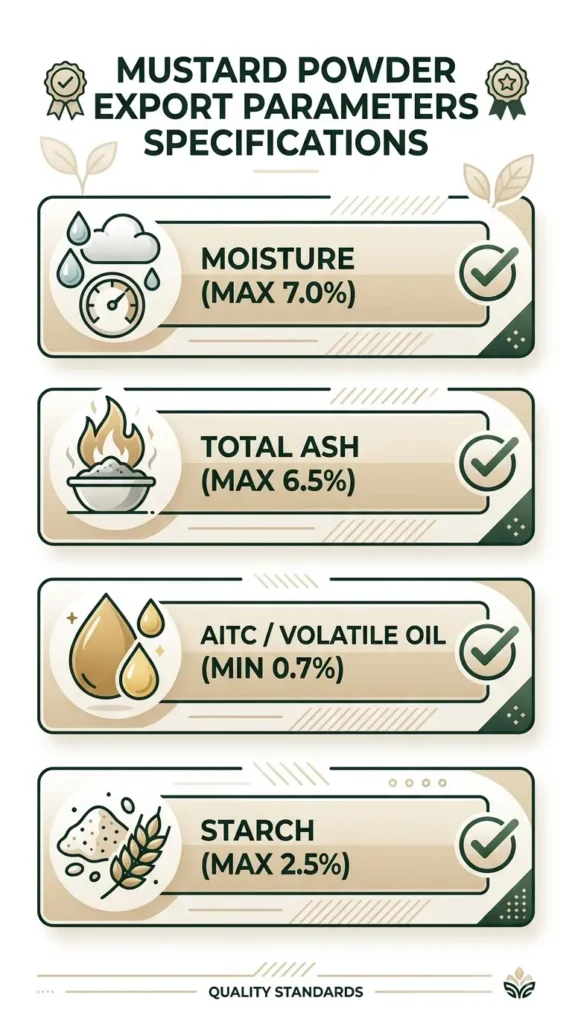
Commercial mustard powder procurement runs on a defined set of chemical thresholds. Moisture is capped at a maximum of 7.0% for ground powder higher moisture accelerates enzymatic degradation, clumping, and mold growth. Total ash must stay under 6.5%, with acid-insoluble ash a direct marker of sand and dirt contamination capped between 0.3% and 1.0% depending on grade.
Non-volatile ether extract, which measures fixed oil content, must hit a minimum of 28% on a dry basis, while volatile oil content sets the real pungency benchmark: brown mustard (B. juncea) requires a minimum of 0.7% AITC, and export-grade specifications typically run 0.3% to 1.0% depending on species and application. Crude fiber is capped around 6.5–8.0% and starch at a maximum of 2.5% starch levels above that threshold are a direct signal of adulteration with cheap cereal flour.
Adulteration Risks Every Buyer Should Screen For
Mustard powder carries real adulteration risk that goes beyond simple dilution. The most serious is contamination with Argemone mexicana seeds, a wild herb that grows alongside mustard crops its alkaloids cause epidemic dropsy and serious organ damage, and international standards mandate its absolute absence, verified through thin-layer chromatography testing.
Dye adulteration is the second major risk, typically non-permitted azo dyes like Metanil Yellow used to brighten low-grade powder into the appearance of premium yellow mustard a toxic compound with documented neurotoxic effects. Starch bulking with tapioca, wheat, or maize starch is more common and less dangerous, but it dilutes volatile oil content and cuts pungency, which is exactly why a Certificate of Analysis with starch and argemone testing should be non-negotiable on every shipment.
HS Codes, Packaging, and Shelf Life
For customs purposes, mustard seeds fall under HS Code 1207.50, while processed mustard flour, meal, and prepared mustard are classified under HS Code 2103.30 getting this distinction right avoids customs delays on international shipments, and buyers can verify current classifications directly through India’s official customs tariff schedule.
Whole seeds hold their oil stability and flavor for 12 to 24 months in cool, dry storage, but once ground, mustard powder is far more exposed oxidation, humidity, and heat degrade volatile oils and myrosinase activity within weeks unless it’s properly packaged. Export shipments are typically packed in 10-25 kg multi-wall Kraft paper bags with food-grade polyethylene liners, and vacuum-sealed packaging extends shelf life back out to 12-24 months by fully excluding atmospheric oxygen.
Which Grade Should You Buy? A Buyer’s Checklist
For mild table condiments and emulsion-heavy applications like salad dressings, specify yellow mustard powder (Sinapis alba) and confirm mucilage-driven water-binding performance rather than pungency. For Dijon-style condiments, curry powders, and high-pungency spice blends, brown mustard (Brassica juncea) with verified AITC content above 0.7% is the standard commercial choice. For pickling applications specifically, request dehusked Rai Kuria to avoid the bitterness whole-hull powder introduces into a liquid brine.
Whatever the end use, insist on a batch-specific Certificate of Analysis confirming Argemone alkaloid absence, starch below 2.5%, and moisture below 7% quality parameters that align directly with FSSAI’s official testing manual for spices and herbs, the regulatory benchmark Indian exporters are held to.
