


Two cardamom lots can look almost identical in a sample bag and still be worth a 30% price difference because the entire grading system runs on a single number most buyers never think to ask for: pod diameter in millimeters. Get that number wrong, or accept a supplier’s word for it without verification, and you either overpay for mid-grade pods dressed up as premium, or underpay expecting a quality the shipment simply doesn’t have.
This guide breaks down exactly how Indian green cardamom grading works the AGEB, AGB, and AGS size classes, what “8mm” and “7mm” actually mean in practice, the official Codex and ISO thresholds behind them, and what to check before you sign a purchase order.
What AGEB, AGB, and AGS Actually Mean
India’s export grading system uses three trade names that every serious buyer should recognize on sight: Alleppey Green Extra Bold (AGEB), Alleppey Green Bold (AGB), and Alleppey Green Superior (AGS). These aren’t marketing labels they’re size-based classifications tied to pod diameter, verified by passing dried pods through calibrated sieves.
Interestingly, the Spices Board of India catalogues these grade names as globally recognized trade terms but doesn’t publish numeric specifications on its own website — exporters instead follow internally maintained grade catalogues that have become industry-standard over decades of trade. That gap is exactly why buyers need to know the numbers themselves rather than relying on a supplier’s grade label alone.
Cardamom Grading 8mm 7mm: The Size Thresholds That Actually Matter
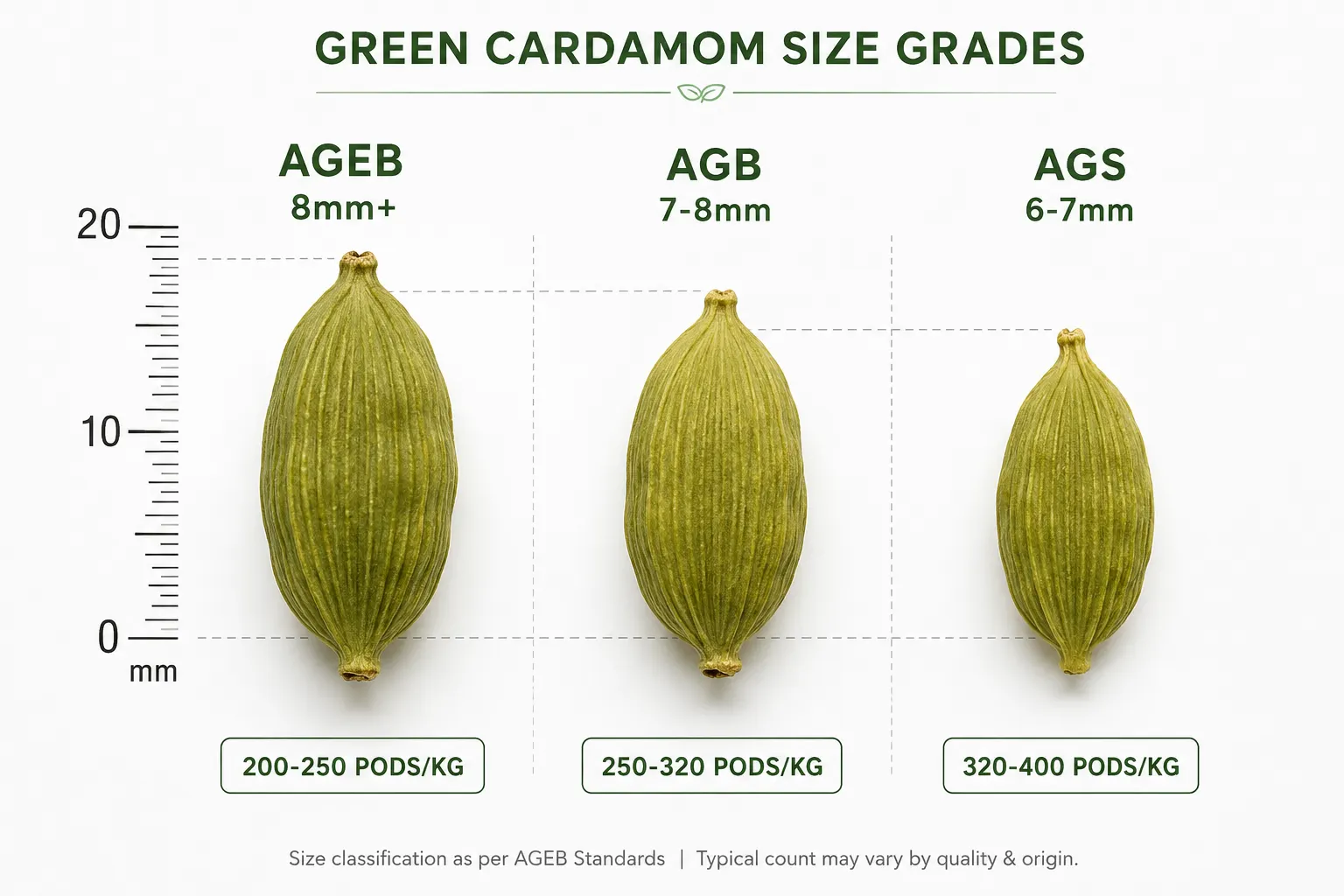
Pod diameter is the primary grading criterion, and the cutoffs work like this: AGEB (Extra Bold) covers pods approximately 8mm and above, AGB (Bold) covers pods in the 7mm-to-8mm range, and AGS (Superior) covers pods roughly 6mm-to-7mm. Some exporters draw the AGS line slightly lower, around 5.5mm to 6.5mm, so it’s worth confirming the exact cutoff your specific supplier uses rather than assuming a universal standard.
Pod count per kilogram is a practical cross-check every buyer can run without lab equipment: Bold-grade (8mm+) pods typically yield 700 to 900 pods per kilogram, while smaller Superior-grade pods run 1,000 to 1,200 per kilogram. If a supplier claims AGEB but a kilogram sample counts out closer to 1,100 pods, that’s an immediate red flag worth raising before the shipment leaves origin.
Bold Green Color: The Visual Quality Marker
Every grade name in this system implies more than size it implies color too. Premium “bold green” pods should show a bright, uniform, glossy green with no sunburn, browning, or yellow patches, and slight color lightening is only acceptable at the AGS end of the scale. Since this remains a visual inspection rather than a spectrophotometric test, reputable exporters keep a reference color chart or sample tray on hand so buyers and graders are judging against the same benchmark.
Color matters enough that it’s also where the most common adulteration risk in cardamom shows up: some suppliers chemically dye naturally pale or yellowing pods to imitate premium green, particularly to disguise older or lower-quality stock. Buyers should watch for uneven color, unnatural streaking, or an artificially uniform saturation that looks slightly off compared to a genuine reference sample.
Bulk Density and Oil Content: The Numbers Behind the Grade
Bulk density — weight per liter with pods loosely filled, not compacted rises predictably with grade: roughly 435 g/L for AGEB, 415 g/L for AGB, and 385 g/L for AGS. It’s a simple, fast test any buyer can run with a one-liter container and a scale, and it’s a strong proxy for pod plumpness even before you check anything else.
Volatile oil content follows the same pattern and matters just as much for flavor delivery: ISO 882-2 sets a baseline minimum of 3.5% for decorticated seeds, but export-grade lots in practice run considerably higher — AGEB often tests at 7-8% oil, AGB around 6-7%, and AGS around 5-6%. A Certificate of Analysis confirming actual lab-tested oil content, not just a size grade, is worth insisting on for any serious contract.
Moisture, Defects, and What Codex Actually Allows
Moisture control sits at the center of quality retention ISO 882-2 permits up to 13% for seeds, but most buyers and exporters target 10% or below in whole pods specifically to prevent mold and aflatoxin risk during transit. The Codex Alimentarius standard for small cardamom (CXS 357-2024) sets the internationally recognized baseline for hygiene and contaminant tolerances that underpin all of this grading activity.
That Codex standard permits up to 7% immature pods, 5% extraneous vegetative matter, 0.5% foreign material like stones or grit, and up to 5 empty or malformed pods per 100 — with zero tolerance for live insects. Indian export practice generally tightens these further at the top grades: AGEB lots typically target extraneous matter closer to 2% rather than the Codex ceiling of 5%, reflecting the premium buyers expect to pay for genuinely clean, high-grade stock.
How Exporters Actually Sort and Verify Grades
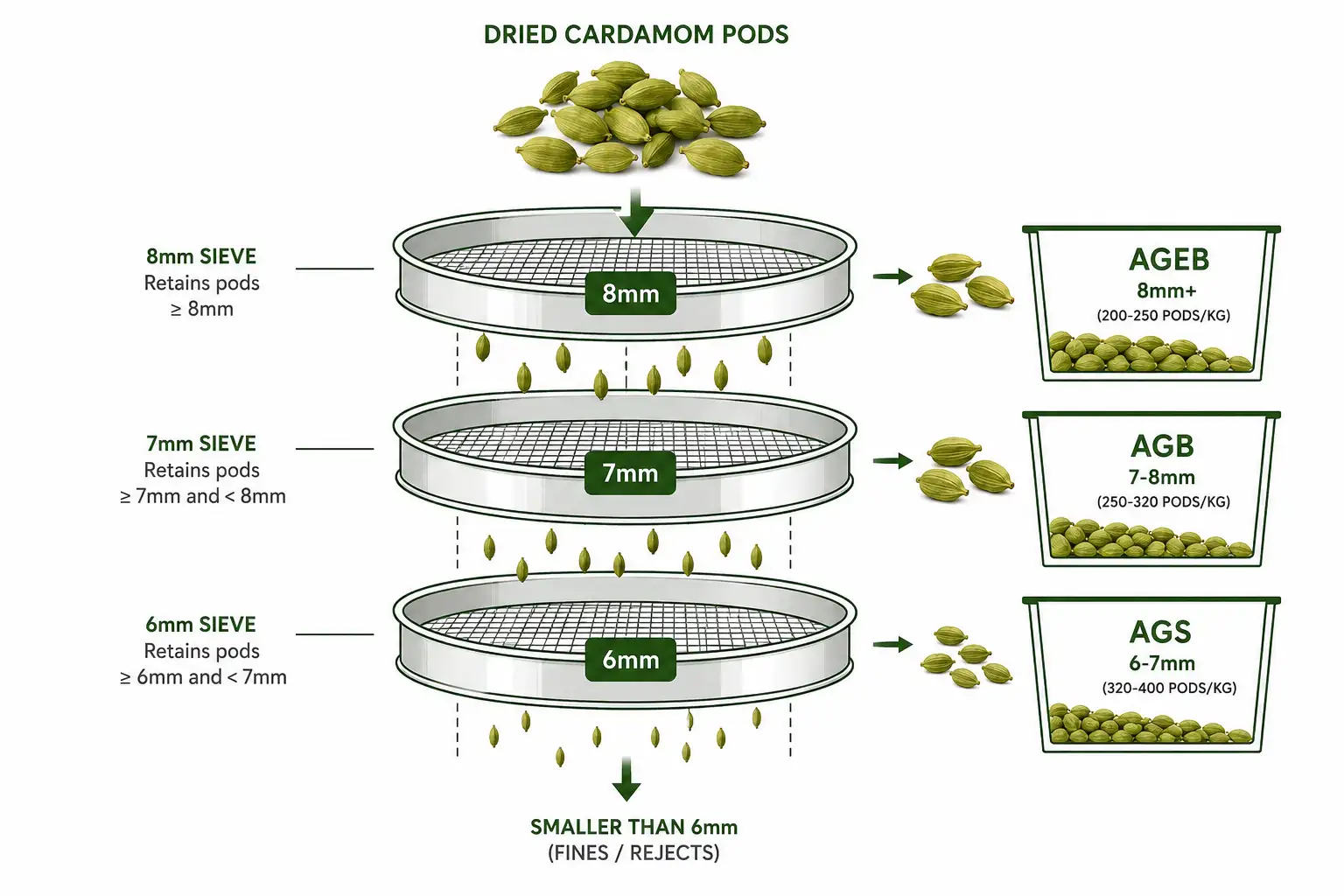
The physical process starts with drying pods down to roughly 10% moisture, followed by preliminary cleaning to remove leaves, stems, and loose debris. From there, dried pods pass through calibrated sieves at 6mm, 7mm, and 8mm apertures pods clearing the 8mm sieve become AGEB stock, those falling between 7mm and 8mm become AGB, and so on down the size chain, with graders manually inspecting each batch afterward for color and defects.
Quality checks don’t stop at sizing. Inspectors sample roughly 100 pods per batch to verify defect percentages against the numbers above, moisture is spot-checked with a calibrated meter or oven-dry test, and export lots undergo formal sampling under ISO 948 protocol drawing multiple sub-samples across a shipment rather than trusting a single scoop from one bag. This is also the stage where Spices Board CRES-registered exporters issue the documentation buyers should expect on every serious export contract.
What This Means for Pricing
Grade differences translate directly into what buyers pay, and the spread is real: Extra Bold Green (8mm and above) commonly commands a 20-30% premium over mid-grade lots. Middle Eastern buyers sourcing for gahwa coffee culture specifically pay top dollar for 8mm+ pods, while UAE re-export buyers more often work in the 7-8mm range, and smaller or mixed lots feed mass-market chai blends and oil extraction at correspondingly lower prices.
Pod count reinforces this economics at equal weight, a bold-grade shipment simply contains fewer, larger pods than a small-grade shipment, so buyers are effectively paying more per kilogram for size and density rather than raw tonnage. For the broader picture on why Indian cardamom has commanded rising global attention overall, see why global buyers are paying a premium for Indian cardamom in 2026.
Regulatory Compliance Beyond Grading
Grade and size aren’t the only boxes a shipment needs to check. Destination markets in the EU and US enforce strict maximum residue limits on pesticides often below 0.01 mg/kg for organochlorine compounds regardless of how impressive a lot’s size or color grade looks. Exporters need valid CRES registration, an FSSAI license, and phytosanitary certification where required, and buyers should independently confirm these rather than accepting a supplier’s assurance verbally.
Market segments also differ meaningfully in what they prioritize. Middle Eastern and high-end Western buyers tend to insist on top color and oil content even at a premium price, while price-sensitive South Asian markets are often willing to accept lower grades in exchange for cost savings. Knowing which segment you’re buying for should shape your grading specification from the outset, rather than defaulting to “premium” or “standard” without defining what those terms actually mean numerically.
Common Quality Issues Beyond Color Adulteration
Dye adulteration gets the most attention, but it isn’t the only quality risk worth screening for. High moisture above roughly 12% creates real mold and aflatoxin risk even in pods that look visually fine, which is why moisture testing should never be skipped in favor of a purely visual inspection. Split or opened pods where seeds are visibly exposed are typically downgraded since aroma escapes quickly once a pod opens, and most standards tolerate only a small fraction of these within an otherwise unopened lot.
Occasional admixture with unrelated Amomum-genus pods, which resemble cardamom but lack its characteristic aroma, is another issue worth screening samples for, particularly on lots sourced through intermediaries rather than directly from processing facilities. None of these checks require sophisticated lab equipment a trained eye, a scale, and a moisture meter catch the majority of real-world quality problems before a shipment ever leaves origin.
A Quick Buyer’s Checklist
Before confirming any cardamom purchase order, verify five things directly rather than taking a grade label at face value: the stated pod size range in millimeters, a Certificate of Analysis showing moisture, oil content, and defect percentages, a physical sample count of pods per kilogram to cross-check the claimed grade, visual inspection for uniform natural green color without dye streaking, and confirmation that the exporter holds valid CRES registration with the Spices Board.
For buyers sourcing premium graded cardamom or by-product cardamom husk for oil extraction and lower-grade blending applications, these same size, density, and moisture parameters apply the checklist doesn’t change just because the end use does.
