


Turmeric is one of the most heavily scrutinized spices in international trade and for good reason. It’s also one of the most adulterated, with a documented history of illegal lead chromate dye used to brighten pale rhizomes into premium-looking golden powder. Whether you’re buying whole cured fingers or ground powder, the form you choose changes not just how the product is used, but how vulnerable it is to that exact kind of fraud.
This guide breaks down what actually separates turmeric finger from turmeric powder, how curing and grinding change the product’s chemistry, the grade specifications buyers should know, and what to verify before signing a purchase order.
What Separates Turmeric Finger from Turmeric Powder
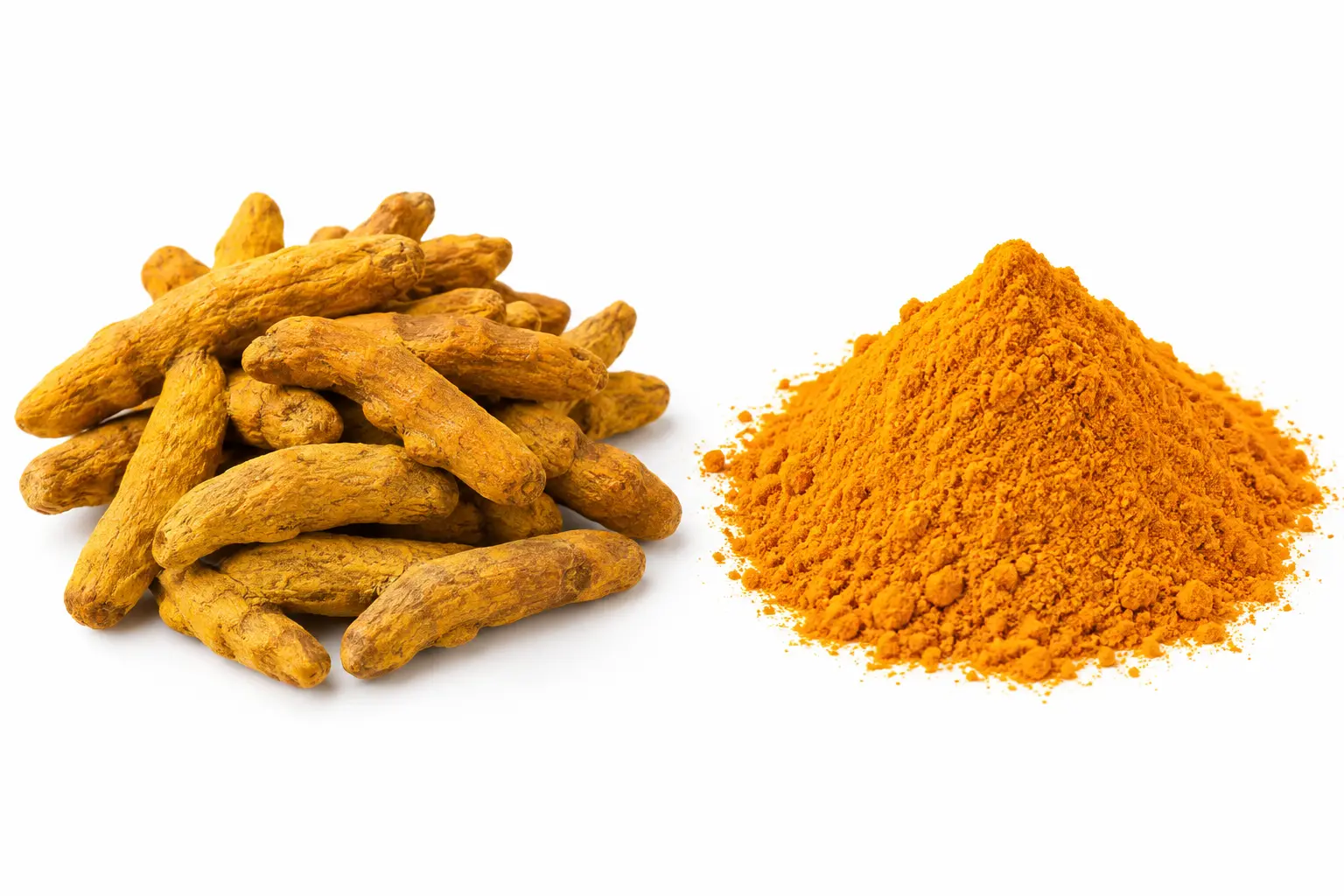
Turmeric finger refers to the whole cured, dried rhizome the root itself, boiled and sun-dried to fix its color and reduce bitterness before export. Turmeric powder is simply that same cured finger ground down to a fine mesh, typically required to pass 98% through a 300-micron sieve for commercial food-grade use.
The distinction sounds simple, but it drives nearly every meaningful difference between the two products: shelf life, adulteration risk, aroma retention, and how each is actually used downstream. A buyer choosing between the two isn’t just choosing a form factor they’re choosing a different risk and quality profile entirely.
How Curing and Grinding Actually Change the Product
Curing is what makes turmeric usable in the first place. Boiling and drying inactivates the rhizome’s sprouting enzymes, fixes its characteristic golden color, and reduces raw bitterness all before moisture is brought down below roughly 12% to prevent spoilage during storage and transit. This process is what separates commercial-grade turmeric from a rhizome fresh out of the ground.
Grinding introduces its own set of trade-offs. Increased surface area accelerates volatile oil loss dramatically cured whole fingers typically retain 5-6% volatile oil, while ground powder drops to just 1-2% within a relatively short window. That’s a real, measurable loss of aroma intensity, and it’s exactly why powder has a shorter effective shelf life than the whole rhizome it’s ground from, even when both are stored under identical conditions.
Turmeric Finger vs Turmeric Powder: Grade Specifications Compared
| Parameter | Turmeric Finger (Whole) | Turmeric Powder (Ground) |
|---|---|---|
| Moisture | ≤12.0% | ≤10.0% (FSSAI), 8-10% (ISO) |
| Total ash (dry basis) | ≤8.0-9.0% | ≤9.0% |
| Acid-insoluble ash | ≤1.5% | ≤1.5% |
| Curcumin (colour) | ≥2% (AGMARK standard) | ≥2% (FSSAI food grade), up to 5% for pharma |
| Volatile oil | ≥2.5 mL/100g | ≥1.5 mL/100g |
| Defective rhizomes | ≤5.0% (shriveled, hollow) | N/A |
| Starch content | N/A | ≤60% (indicates dilution) |
| Lead chromate test | Negative (mandatory) | Negative (mandatory) |
Notice that curcumin the compound actually responsible for turmeric’s color, flavor, and increasingly its nutraceutical value carries the same 2% food-grade minimum across both forms, but premium and pharmaceutical buyers routinely push that requirement up to 3-5% or higher, particularly for high-curcumin cultivars like Lakadong and Alleppey turmeric.
Curcumin Content: The Number That Actually Matters
While moisture and ash define baseline acceptability, curcumin content is what actually determines a lot’s commercial value. It’s measured either by HPLC with a reference standard or by UV-Vis spectrophotometry at 425nm absorbance, and it’s the single figure buyers should ask for by name rather than trusting a general “premium” label.
Standard food-grade turmeric typically runs at the 2-3% curcumin threshold, while high-curcumin varieties command a genuine 2-3x price premium precisely because of this metric. For buyers supplying nutraceutical or pharmaceutical-grade extraction, curcumin content of 5% or higher is often the minimum starting point a specification that should be written into the contract explicitly, not assumed from a supplier’s marketing language.
The Lead Chromate Problem: Why Turmeric Needs Extra Scrutiny
Turmeric carries a documented, serious adulteration risk that sets it apart from most other spices: lead chromate, sometimes marketed under the euphemism “Brilliant Yellow,” has repeatedly been found used to artificially brighten pale or lower-grade turmeric into the appearance of a premium golden lot. This isn’t a minor quality issue lead chromate contamination is a genuine public health hazard, and it’s exactly why both AGMARK and FSSAI standards mandate an explicit negative lead chromate test on every commercial batch, for both fingers and powder.
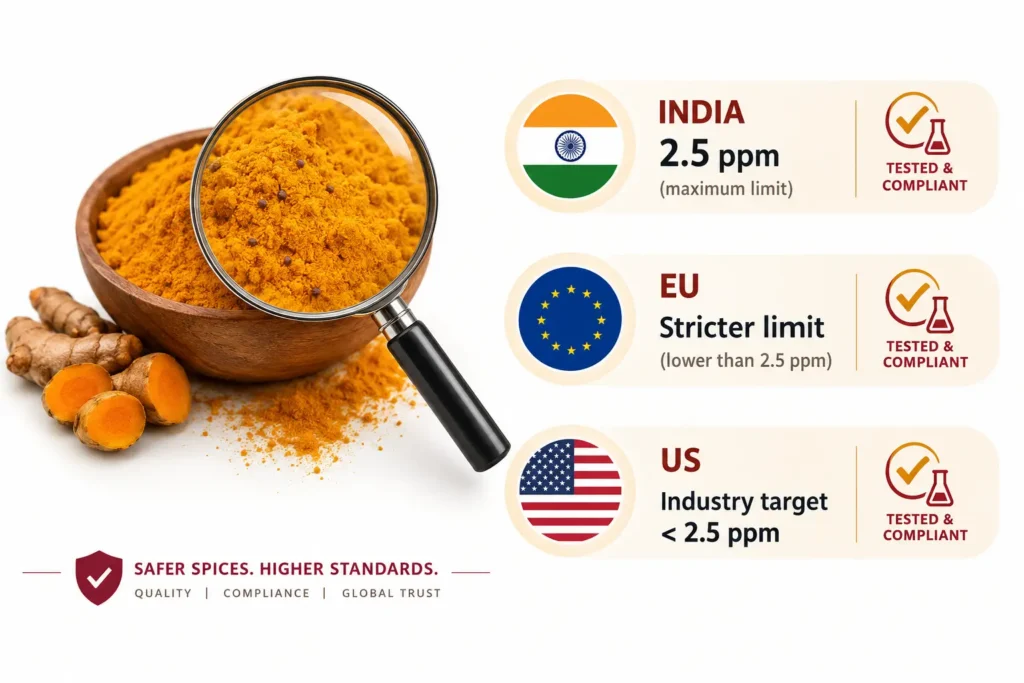
Regulatory limits on lead itself vary meaningfully by destination market, which matters for anyone shipping internationally. India and Bangladesh generally work within a 2.5 ppm lead threshold, while EU Commission Regulation 2023/915 which explicitly cites the fraudulent addition of lead chromate to turmeric as a driving reason for its stricter limits has moved toward a considerably tighter threshold for dried spices, and while the US FDA has no spice-specific lead limit, industry practice commonly targets below 2.5 ppm as a working standard regardless of the legal floor. Buyers sourcing for EU or pharmaceutical markets specifically should request lead testing via ICP-MS with a stated limit of quantification, not just a pass/fail chromate screen.
Shelf Life and Storage: Finger vs Powder
Properly cured and packaged turmeric finger, stored in poly-lined jute sacks or kraft bags at low humidity, holds its quality for roughly 1-2 years. Powder is considerably more fragile even with good packaging, unsealed or poorly stored powder can lose noticeable color and aroma within just 6-9 months, driven by that faster volatile oil loss from grinding.
This is a genuinely practical consideration for procurement planning: buyers ordering turmeric well ahead of anticipated use, or building safety stock, are generally better served sourcing whole fingers and grinding closer to the point of use, reserving pre-ground powder purchases for shorter-cycle, faster-turnover supply chains.
Which Should Buyers Choose: Finger or Powder?
The right choice depends almost entirely on end use and turnover speed. Buyers needing ready-to-use product for immediate blending or retail packaging are better served by powder, which disperses easily and requires no further processing. Buyers extracting curcumin or turmeric oil for pharmaceutical and cosmetic applications generally prefer powder too, since it offers more consistent extraction yields than grinding fingers in-house batch by batch.
Buyers prioritizing maximum shelf life, aroma retention, and lower adulteration risk since whole rhizomes are structurally harder to dye or bulk with starch than a fine powder is are typically better served sourcing turmeric finger directly and controlling the grinding step themselves. For ready-to-use applications where convenience outweighs those advantages, turmeric powder remains the more practical choice.
Global Market Requirements: India vs EU/US vs Middle East
Requirements diverge meaningfully by destination. India’s FSSAI and AGMARK standards form the domestic baseline, generally permitting foreign matter up to 1-4% depending on grade. EU and US buyers typically demand tighter foreign matter limits under 2%, alongside far stricter pesticide residue panels under regulations like EU 396/2005, and increasingly push for lead limits below the older 2.5 ppm Indian standard.
Middle East and GCC markets largely mirror Codex and EU benchmarks but add halal certification requirements and, in many cases, stricter enforcement around any trace of banned dyes given the region’s heightened sensitivity to turmeric adulteration incidents. The Codex Alimentarius standard for dried turmeric (CXS 359-2024) increasingly serves as the common reference point buyers across these regions cite when specifying international-grade turmeric in contracts.
A Buyer’s Verification Checklist
Before confirming a turmeric purchase order, five checks separate a properly specified contract from a vague one: state curcumin content as a specific percentage rather than accepting “premium” as a descriptor; request an explicit negative lead chromate test result alongside quantitative lead, cadmium, and arsenic figures via ICP-MS; confirm moisture is documented at or below 10-12% depending on form; for powder specifically, request starch content data, since anything above the 60% dilution threshold signals adulteration; and specify whether you need whole finger or ground powder based on your actual shelf-life window and processing capability, rather than defaulting to whichever form a supplier happens to have in stock.
Shree Agro International supplies both export-grade turmeric finger and turmeric powder, tested and documented against these exact parameters for buyers across food, nutraceutical, and industrial applications.
Conclusion
The difference between turmeric finger and turmeric powder isn’t just about convenience — it’s a genuine trade-off between shelf life, adulteration exposure, and processing flexibility, layered on top of a spice with one of the trade’s most serious documented contamination risks. Buyers who specify curcumin percentage, demand explicit lead and lead-chromate testing, and choose form factor based on their actual turnover speed are the ones who consistently receive what they actually paid for.
So before your next turmeric order goes out: does your specification name curcumin content and lead testing explicitly, or is “export-grade” still doing all the work a Certificate of Analysis should be doing instead?
