


Cumin and fennel seeds sit next to each other on almost every spice rack, share the same botanical family, and still couldn’t taste more different from one another. Mix them up in a formulation or worse, receive one adulterated with the other in a bulk shipment and the finished product’s flavor profile changes completely. One brings warm, earthy heat; the other brings sweet, licorice-like brightness, and no amount of adjusting quantities fixes a batch where the wrong seed went in.
This guide breaks down exactly how cumin and fennel differ botanically and chemically, why the two occasionally get confused in commercial supply, and what buyers should check before placing an order.
Same Family, Completely Different Seeds
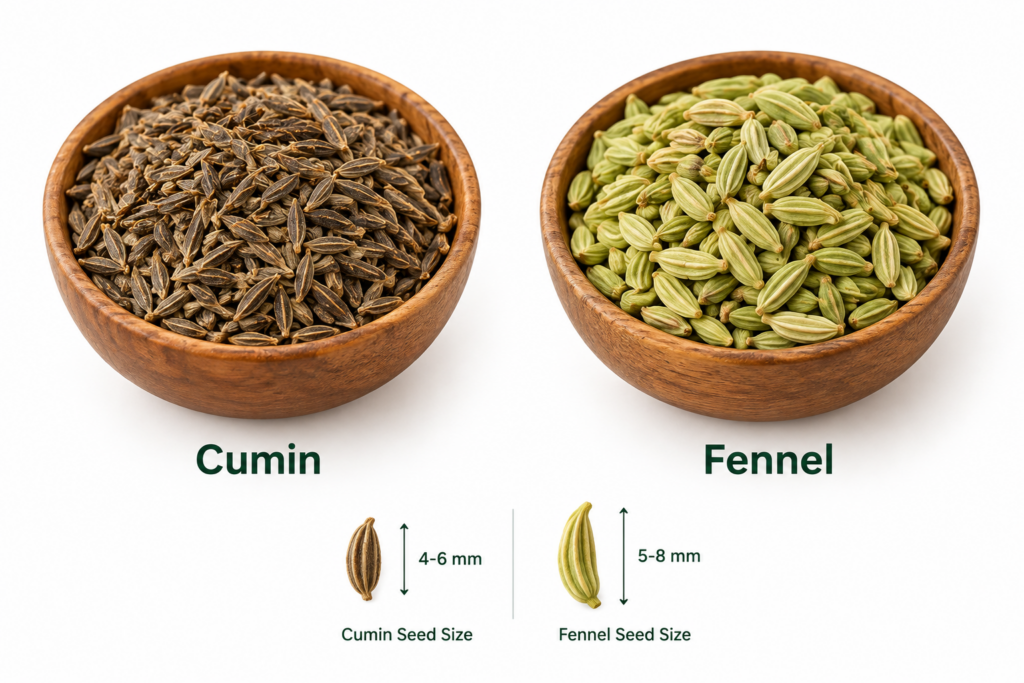
Cuminum cyminum (cumin) and Foeniculum vulgare (fennel) both belong to the Apiaceae family the same botanical family as carrots and parsley and both produce the characteristic compound umbels and schizocarpic fruits typical of that family. That shared ancestry is exactly where the similarity ends.
Cumin is a small annual herb that thrives in arid, semi-arid Mediterranean and South Asian conditions, producing slender, elongated fruits 4-6mm long with a dark brownish-grey color and prominent hairy ridges. Fennel, by contrast, grows as a hardy biennial or perennial capable of adapting across a much wider range of temperate and subtropical climates, producing larger, plumper schizocarps 5-8mm long in a pale green to yellowish-brown shade, with smooth elevated ribs and a slightly curved, crescent-like shape.
Cumin vs Fennel: What the Chemistry Actually Says
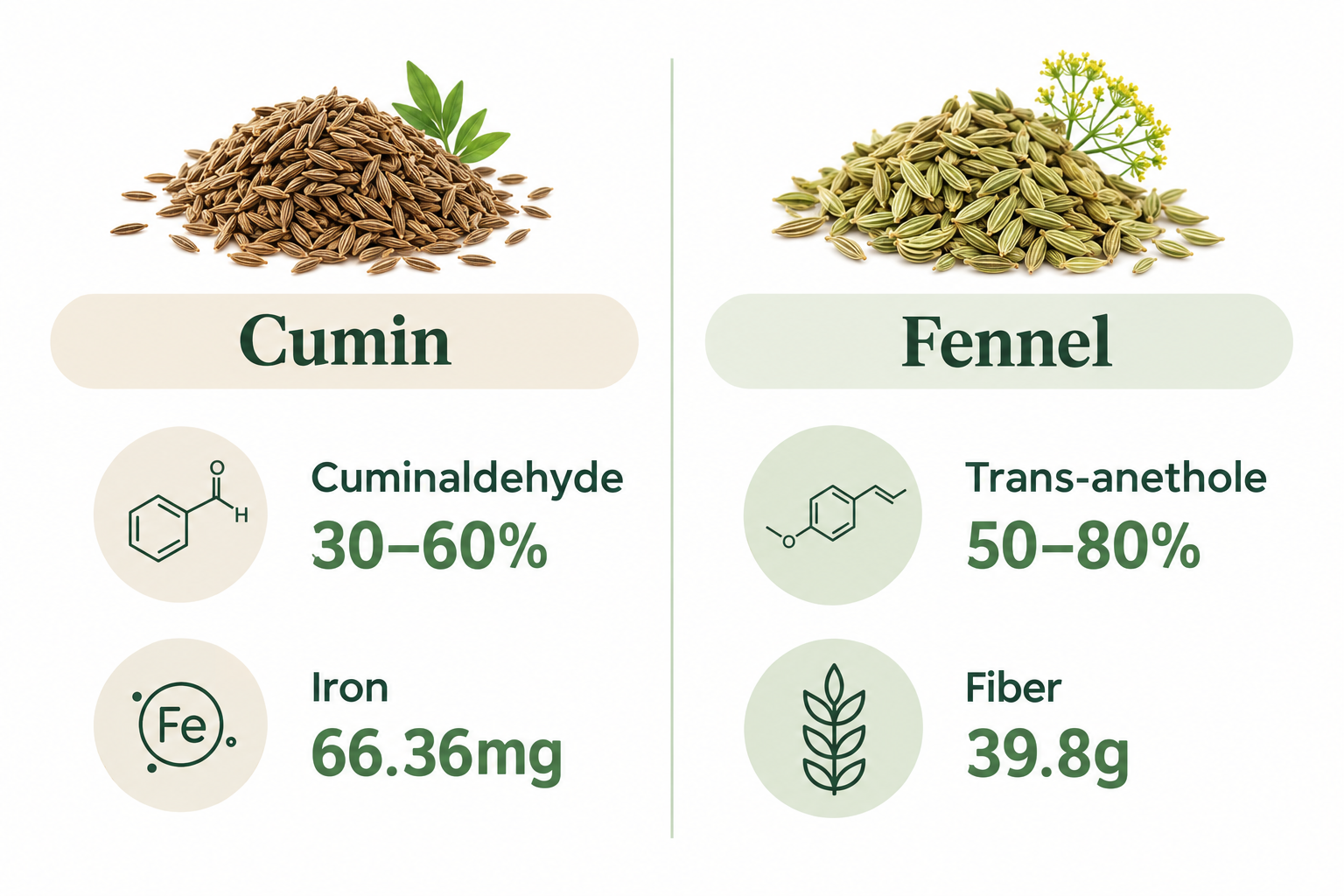
The real story behind why these two spices taste nothing alike is chemical, not just visual. Cumin’s essential oil biosynthesis runs through the monoterpenoid pathway, producing cuminaldehyde as its defining compound typically 30% to 60% of total volatile oil in high-grade cultivars, delivering that unmistakable warm, pungent, earthy character.
Fennel’s essential oil takes an entirely different biosynthetic route through the shikimate pathway, producing phenylpropanoids instead. Trans-anethole dominates fennel oil at 50% to 80% of total volatile content, delivering the sweet, licorice-like brightness fennel is known for, alongside smaller amounts of estragole and fenchone, which add a bitter, camphoraceous edge. Interestingly, cuminaldehyde and trans-anethole share an identical molecular formula despite tasting completely different the distinction comes down to functional group structure, an aldehyde on a benzene ring versus an ether linked to a propenyl chain, which changes how each compound binds to olfactory receptors entirely.
Why Fennel Sometimes Shows Up in Cumin Shipments
This chemical gap isn’t just academic it’s the basis for a real, documented adulteration issue in commercial spice trade. Because cumin and fennel seeds can look superficially similar in poor lighting or low-quality sorting conditions, and because cumin often commands a higher price with more volatile supply, commercial lots are occasionally cut with spent or whole fennel seed to increase weight and reduce cost.
Fortunately, this substitution is straightforward to catch with the right test. Since trans-anethole is entirely absent in genuine Cuminum cyminum, its presence in a Gas Chromatography-Mass Spectrometry scan serves as a definitive chemometric marker for fennel adulteration detectable down to a 1% threshold. Any buyer sourcing cumin at commercial volume should treat a trans-anethole-clean GC-MS report as standard due diligence, not an optional extra.
Flavor and Culinary Roles: Why You Can’t Swap One for the Other
Cumin brings an intense, warm, earthy, slightly bitter taste with smoky undertones that deepen further when dry-roasted, as heat breaks down its monoterpene fractions into pyrazines and other savory, nutty compounds. That robust character makes it foundational across Latin American, Middle Eastern, North African, and South Asian cuisine grounding heavy meats, legume stews, curries, and chili preparations.
Fennel delivers something almost opposite: a sweet, refreshing, anise-like brightness with herbaceous undertones, driven by its high trans-anethole content. That profile makes it central to Italian sausage, Mediterranean fish preparations, European rye breads, and confectionery, and in South Asian tradition, raw or sugar-coated fennel seeds (saunf) are served after meals as a digestive aid and breath freshener. Direct substitution between the two genuinely doesn’t work swapping cumin into a dish built around fennel introduces heavy earthy notes where sweet anise flavor was intended, and the reverse creates an equally jarring mismatch.
How Traditional Spice Blends Use the Contrast Deliberately
Rather than avoiding the difference between cumin and fennel, several traditional spice blends use it deliberately for balance. In Bengal’s Panch Phoron five-spice mix, whole cumin, fennel, mustard, fenugreek, and nigella seeds are tempered together in hot oil cumin’s earthy bitterness anchors the blend while fennel’s sweet volatility softens the sharper bite of mustard and fenugreek.
Chinese Five Spice takes the opposite approach entirely, building around fennel alongside star anise, cinnamon, clove, and Sichuan pepper while omitting cumin completely, keeping the profile sweet and aromatic without cumin’s heavier, earthier undertone. That deliberate inclusion or exclusion is itself a useful signal for buyers: a blend recipe calling specifically for one seed over the other usually isn’t interchangeable without changing the product’s identity.
Nutritional Comparison: Where the Numbers Diverge
Beyond flavor, cumin and fennel differ meaningfully in nutritional composition per 100 grams. Cumin runs higher in calories (375 kcal versus fennel’s 345) and total fat (22.27g versus 14.87g), while fennel pulls dramatically ahead in dietary fiber at 39.8g compared to cumin’s 10.5g a difference relevant to buyers supplying the functional food and fiber-supplement segment specifically.
Mineral profiles diverge too. Cumin is an exceptionally concentrated iron source at 66.36mg per 100g, more than three times the daily recommended value, making it genuinely useful as a non-heme iron source in plant-based product formulation. Fennel instead leads in calcium (1,196mg versus cumin’s 931mg) and dietary fiber, positioning it differently for buyers targeting bone-health or digestive-wellness product lines. According to Spices Board of India’s official flavor profile documentation, these compositional differences are exactly what underpin each spice’s distinct culinary and functional positioning in the global market.
Functional Properties Relevant to Product Formulation
Beyond flavor and basic nutrition, cumin and fennel diverge in the functional properties that matter to buyers formulating supplements, functional foods, or wellness-positioned products. Fennel’s dominant compound, trans-anethole, acts as a genuine smooth-muscle relaxant by modulating voltage-gated calcium channels in intestinal tissue the biochemical basis for its long-standing traditional use as a post-meal digestive aid. Cumin instead stimulates gastric acid secretion, pancreatic lipase activity, and bile acid production, positioning it functionally as a digestive stimulant rather than a relaxant.
Both essential oils also show documented antimicrobial activity against common foodborne pathogens including E. coli, Staphylococcus aureus, and Bacillus cereus, which is relevant for buyers in natural preservation or clean-label antimicrobial applications. This functional divergence stimulant versus relaxant, iron-dense versus fiber-dense is exactly why product formulators typically choose one over the other based on the specific physiological outcome they’re targeting, rather than treating them as generically interchangeable “digestive spices.”
What Buyers Should Verify Before Ordering
For buyers sourcing either spice at commercial volume, a few checks go a long way toward avoiding costly mismatches. Physical inspection should confirm color and size cumin’s dark brownish-grey, slender 4-6mm fruits versus fennel’s pale green to yellowish 5-8mm plumper seeds since a visibly mixed lot is often the first sign of cross-contamination during harvest or processing. For cumin specifically, requesting GC-MS confirmation of zero trans-anethole content protects against fennel adulteration on any order where purity genuinely matters to the end formulation.
It’s also worth specifying end-use clearly when placing an order, since grade requirements differ: culinary-grade cumin for grinding into curry powders has different cleanliness thresholds than cumin destined for essential oil extraction, and the same logic applies on the fennel side between whole-seed retail packaging and oleoresin processing. For processing infrastructure specifics, Gujarat’s official cumin and fennel essential oil processing guidelines outline the state-level processing standards exporters in the region work against.
Quick Reference: Cumin vs Fennel Seeds
| Feature | Cumin (Cuminum cyminum) | Fennel (Foeniculum vulgare) |
|---|---|---|
| Seed size | 4-6mm | 5-8mm |
| Color | Dark brownish-grey | Pale green to yellowish-brown |
| Shape | Straight, hairy ridges | Plump, curved, smooth ribs |
| Dominant compound | Cuminaldehyde (30-60%) | Trans-anethole (50-80%) |
| Flavor | Warm, earthy, bitter | Sweet, anise-like, licorice |
| Iron (per 100g) | 66.36 mg | 18.54 mg |
| Fiber (per 100g) | 10.5 g | 39.8 g |
| Key uses | Curries, chili, Garam Masala | Saunf, Italian sausage, confectionery |
Shree Agro International supplies export-grade cumin seeds alongside fennel seeds and fennel powder, each processed and graded to the purity thresholds their respective end uses demand.
