


 Cardamom just quietly became the biggest growth story in India’s entire spice export basket and most people outside the trade have no idea it happened. Export value has nearly tripled in two years, auction prices have hit record highs, and buyers who once ignored Indian pods in favor of cheaper origins are now placing urgent orders. This isn’t a temporary spike either; it’s the result of a genuine shift in global supply and buyer preference that’s likely to shape the market well into 2027 and beyond.
Here’s what’s actually driving the surge, who’s buying, and what it means if you’re sourcing or exporting cardamom right now.
The Numbers Behind the Boom
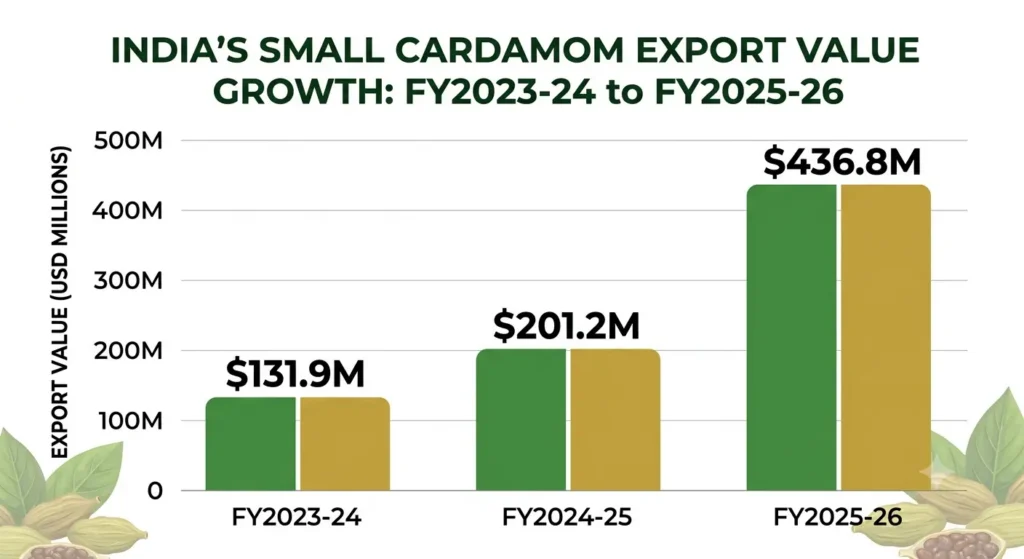
India’s small cardamom exports jumped from 7,083 tons worth $131.9 million in FY 2023–24 to roughly 16,399 tons worth $436.8 million in FY 2025-26 more than tripling in value in just two years. Average export prices climbed alongside volume too, from around $18.6/kg to $26.7/kg over the same period, which tells you this isn’t just a bigger crop being dumped on the market at lower prices.
Domestic auction prices tell the same story. Rates that averaged around ₹657/kg in 2021–22 have climbed past ₹3,000/kg on average by mid-2026, with top-quality 8mm “extra bold” pods hitting bids as high as ₹4,520/kg at a single Kerala auction in July 2026. This data lines up closely with what’s covered in the broader spice-wise export demand breakdown for 2026, where cardamom already stood out as the fastest-growing category in India’s five-year export data.
Why Guatemala’s Slump Became India’s Opportunity
For years, Guatemala dominated the global cardamom trade on volume and price, often undercutting Indian exporters even when Indian pods were the better product. That changed fast. Drought and pest pressure cut Guatemalan output by roughly half between 2023 and 2025, and recovery has been slow due to limited replanting.
That supply gap redirected serious buyer attention toward India almost overnight. Kerala exporters describe Gulf buyers who previously wouldn’t even look at Indian quotes now reaching out directly and aggressively for supply. It’s a rare case where a competitor’s crisis became a structural opening for Indian exporters, not just a short-term price bump.
Quality Is the Real Differentiator
Supply shortages alone don’t explain why buyers are willing to pay 20 to 30% more for Indian cardamom over comparable Guatemalan grades quality does. Indian pods, particularly Kerala’s “Extra Bold” 8mm-plus grades, consistently show higher seed-to-husk ratios and volatile oil content of 6 to10%, compared to just 2 to 5% in many Guatemalan varieties.
That oil content is what actually delivers flavor. Indian cultivars carry higher concentrations of cineole and terpinyl acetate the aromatic compounds responsible for cardamom’s signature sweetness and depth which is exactly why buyers in demanding markets keep coming back for it. India’s rigorous 25-tier export grading system, combined with GI-tagged origins like Alleppey and Coorg, gives international buyers a level of traceability and consistency that’s genuinely hard to match elsewhere.
Who’s Actually Buying: The Middle East Story
Over 60% of India’s cardamom exports now flow to the Gulf region, led by the UAE ($135.2 million) and Saudi Arabia ($125.2 million) in FY 2025–26, followed by Bangladesh, Kuwait, and Iraq. The core driver is cultural, not just commercial cardamom is central to gahwa, the traditional Arabic coffee served during Ramadan, Eid, and daily social gatherings across the Gulf.
That demand is deeply seasonal but remarkably reliable, spiking hard around religious holidays and staying strong through the rest of the year on everyday consumption. Beyond the Gulf, a smaller but growing segment of EU and US buyers are seeking out GI-certified, organic, and traceable Indian cardamom for premium retail and gourmet food applications a segment that rewards exactly the qualities Indian cardamom already has.
How Prices Actually Get Set
Unlike commodities with active futures markets, Indian cardamom trades almost entirely through weekly physical auctions in Kerala, run by cooperatives and private auctioneers. There’s technically a futures contract on the MCX, but it’s seen essentially no trading volume and has sat frozen near ₹1,450/kg since it launched meaning there’s no real hedging mechanism for buyers or exporters.
That leaves auction prices as the base for every export quote, with exporters adding handling and margin on top. It also means prices can swing sharply within a single season based on arrivals, weather, and speculative buying something exporters increasingly account for with flexible or dollar-indexed pricing terms rather than long fixed-price contracts.
Regulatory Landscape and Trade Support
On the compliance side, buyers in the EU and US are tightening pesticide residue limits and audit requirements, pushing Indian exporters toward GAP certification and stricter residue testing through the Spices Board’s quality programs. According to the Spices Board of India’s official trade data, small cardamom was already the fourth-largest contributor to India’s total spice export value in FY 2025–26, right behind chilli, cumin, and spice oils.
On the trade-policy side, recent developments have been broadly favorable. Under the India-US trade agreement announced in early 2026, spices including cardamom were among the agricultural products granted zero reciprocal tariff treatment for exports to the United States, as confirmed in an official government trade briefing. That kind of tariff certainty matters for exporters trying to plan contracts a year or more out.
What This Means for Sourcing and Exporting
The practical takeaway for anyone sourcing cardamom right now is that grade matters more than ever. The gap between standard 6–8mm lots and premium 8mm-plus “Extra Bold” grades has widened significantly, and that gap is where most of the margin now sits. Buyers focused purely on lowest landed cost are increasingly competing against buyers who specifically want India’s oil-rich, GI-tagged pods and are willing to pay for them.
For exporters, this is also a moment where the same quality-first approach already proving out in turmeric finger sourcing and clove export demand applies directly to cardamom buyers across nearly every high-value spice category are rewarding certified, traceable, high-oil-content product over generic bulk lots.
The Logistics Squeeze Nobody Talks About
Rising demand and higher prices don’t mean fatter margins across the board shipping costs have quietly eaten into a lot of the upside. A 20-foot container from India to Europe now runs $3,000–3,100 on a CFR basis, plus another $250 or so for insurance and fuel surcharges, with inland haulage from Kerala’s hill estates to ports like Cochin or Mundra adding another $1,000–1,500. Put together, farm-to-Europe logistics costs have roughly doubled compared to pre-2020 levels.
That matters more for lower-grade lots than premium ones. A $35/kg 8mm “Extra Bold” pod can absorb a higher freight cost far more comfortably than a commodity-grade lot competing purely on price. It’s another quiet reason the market is tilting toward premium grades the economics of shipping itself now favor quality over bulk.
Where This Is Headed
Short-term, most analysts expect some cooling as India’s 2025 harvest recovery continues and domestic auction rates ease off their peaks likely settling somewhere in the ₹1,800–2,200/kg range by late 2026, still well above pre-boom levels. Export volumes, though, are expected to hold up as long as Gulf demand stays strong through Ramadan and Eid cycles.
The medium-term picture depends heavily on what Guatemala does next. If Guatemalan growers replant aggressively and output climbs back toward 40,000–50,000 tons by 2027–28, global supply could loosen and compress prices again. If that recovery stays slow which is the more likely scenario given the scale of recent crop losses India is well positioned to hold onto both the market share and the price premium it’s gained, particularly if it keeps investing in yield improvement and GI/organic branding rather than just riding the current price wave.
What Exporters and Buyers Are Actually Saying
Kerala exporters describe this moment as a genuine turning point rather than a temporary windfall. Several note that Indian cardamom’s superior oil content was never really the problem it simply couldn’t compete on price against cheaper Guatemalan bulk supply before the shortage hit. Now that the price gap has narrowed, buyers who previously defaulted to Guatemala are evaluating Indian pods on quality alone, and Indian exporters are seeing real, sustained interest from Saudi, UAE, and Kuwaiti buyers rather than one-off opportunistic orders.
On the buyer side, Gulf importers consistently point to consistency as the deciding factor fewer Indian pods are needed to achieve the same flavor intensity in gahwa compared to lower-oil alternatives, which offsets the higher per-kilogram price in practical terms. European buyers, meanwhile, tend to cite India’s GI tags and organic certification options as a better fit for clean-label retail trends than what Guatemala typically offers. Exporters do flag one real challenge, though: sharp week-to-week auction price swings make it genuinely difficult to commit to long-term fixed-price contracts, which is pushing more deals toward dollar-indexed or short-cycle pricing structures.
